A personal message from Oregon Chang

Have you had a close encounter story or witnessed something unusual that you would like to share?

Do you wish to collaborate with Asia Paranormal through link or content exchange?

Do you have any enquiries or feedback?

Email us at AsiaParanormal@gmail.com

We look forward to hearing from you!

Follow us on Subscribe Asia Paranormal in your favorite reader. Follow Asia Paranormal in Facebook. Follow Asia Paranormal in Twitter. Follow Asia Paranormal Youtube channel.

Vote for us! We are listed at the www.topparanormalsites.com website. Click here to vote for us.. Thank you :-)

Best regards, on behalf of team AsiaParanormal

Master Orthodox Occultist Oregon Chang, The 17th generation Disciple of Seven Stars Sword Master Hebei China

Showing posts with label Anomalous History. Show all posts

Wednesday, December 19, 2012

Ancient City Found in India, Irradiated from Atomic Blast

Radiation still so intense, the area is highly dangerous. A heavy layer of radioactive ash in Rajasthan, India, covers a three-square mile area, ten miles west of Jodhpur. Scientists are investigating the site, where a housing development was being built.

For some time it has been established that there is a very high rate of birth defects and cancer in the area under construction. The levels of radiation there have registered so high on investigators' gauges that the Indian government has now cordoned off the region. Scientists have unearthed an ancient city where evidence shows an atomic blast dating back thousands of years, from 8,000 to 12,000 years, destroyed most of the buildings and probably a half-million people. One researcher estimates that the nuclear bomb used was about the size of the ones dropped on Japan in 1945.

[Click here to read full article]
Read more >>

Friday, June 29, 2012

Why are there spaceships in Medieval art?

Medieval art can sometimes surprise you, with its rich colors and expressive subjects. But sometimes, you're also caught off guard by the shock of noticing the presence of a guy in a spaceship in a painting of the crucifixion. Find out why there are so many UFOs in paintings from hundreds of years ago.
So, you are wandering around the streets of Metohia, Yugoslavia, as one does, and decide to spend some time in the Visoki Decani Monastery. You take in the atmosphere slowly, looking at the thickness of the walls — built in 1330 and still standing — and the wooden sarcophagus of King Stefan. And gradually you come up to the altar, looking at the fresco above it. Reading the informational sign next to it, you see that it was completed in 1350, which, you think, is fine, but could someone explain to you why someone in 1350 was doodling space ships above the scene of the crucifixion?

To the left of Jesus, in the sky, is something that looks like a comet with a multifaceted trail behind it. One side, though, is transparent, and inside sits a small figure. In the sky on the far right of the painting is something that wouldn't look out of place in a drawing from the height of the 1960s space age. There's a rounded ship with a pointed nose cone in front, a transparent scooped window for a cockpit, and three turrets in the back that look like landing struts. The shape and aesthetic are so familiar that it's impossible to read as anything other than a spaceship.

That example is what people first point to when they talk about UFOs in medieval art, but it's not the only thing they point to. In other artwork there are golden disks shooting down lights that look like tractor beams onto the faithful. There are random ovals, with what look like wires coming out of them, over the shoulder of the Virgin Mary while she's holding the baby Jesus. There are disks in the sky in some paintings and what look like crude pictures of the flying saucer in the "I Want To Believe" poster above people's heads in others.

But the space ship in the Decani fresco is the most obvious picture of what we would think of as a spaceship. What are they?

[Click here to read full article]
Read more >>

Monday, March 12, 2012

Is There Evidence of Advanced Technology in Ancient Hopi Culture?

by Micah Hanks

Years ago, I recall doing an interview with a very skeptically-minded cosmologist, who on occasion would humor journalists by fielding questions about UFOs, most–if not all of which–he believed, could be explained away through the marvelous knowledge base of the modern sciences. When asked if he believed humankind had ever had interaction with advanced extraterrestrial intelligences, he replied, “I don’t think there’s any evidence of that sort of thing in recent times, although I wouldn’t be surprised at all if hadn’t likely happened in prehistoric times.”

I found this statement rather interesting, since it seemed to allude to the very same sort of sentiment expressed within the UFO circles: that mankind may have had “help” at various times along the way in our lineage of coming to hold the position of dominance among species here on Earth. It was particularly strange to hear it coming from this individual, however, since this position is often criticized heavily by the science-minded for doubting the ingenuity and natural prowess of mankind as a species, instead favoring the position that we could not have achieved what we have on our own.

Regardless of what position on the matter one may hold, it cannot be dismissed that a multitude of ancient sacred and religious texts from around the world can be interpreted as dealing with this approach: from the Sanskrit epics of ancient India, rife with their reports of flying “vimanas” and advanced sounding weapons, to similar rich traditions found amidst cultures of ancient Mesopotamia, there are many who claim that evidence of a far greater level of advancement existed on Earth thousands of years ago… the question, of course, has to do with whether such proposed advanced technologies were our own, or if they came from someplace else.

[Click here to read full article]
Read more >>

Tuesday, February 21, 2012

Giant Foot Print 200 Million Yrs Old - South Africa

Michael Tellinger shows off what could be one of the best pieces of evidence that there were giants on Earth a long, long time ago. Geologists have marvelled at this giant foot print in rough granite, about 4 feet long. Some still say that it is a natural erosion pattern.

Read more >>

Tuesday, January 31, 2012

Ancient Chariots of Alien Gods: The Great Vimana Controversy

by Micah Hanks

The ancient Hindu epics are rife with tales of the strange and fantastic. Elements described within consist of elaborate tales of massive wars, superheroes, and gods that walk alongside common mortals. And yet, perhaps no subject hailing from the Sanskrit fables has captured the minds of ancient mystery proponents better than the flying vehicles of ancient India, known today as vimanas.

Vimanas are, without question, mentioned throughout many of the ancient Vedic texts, proving they certainly are not a concept that originates entirely from recent times; but if not sophisticated avionics of the modern variety, what then might they have been? Could it be possible that some elements regarding the vimana mystery–specifically our interpretation of these objects as technologically advanced aircraft that existed in ancient India–could be a result of our own desire to superimpose modern themes and ideas into the framework of the ancient Indian epics?

Before we get to the discussion of flying craft, there are a few things we must look at first with regard to the exact meaning of what a “vimana” is, in order to better unravel why I feel there may be misinterpretation associated with their presence in literature. One thing that we must take into consideration is that “vimana” is a word used to describe a number of things in a variety of different contexts throughout the Vedas. For instance, vimana can translate to mean the innermost sanctuary of a Rama temple (sometimes called an “adytum,” though this word actually has its origins in the Greek, rather than the Sanskrit). A variety of different temples, palaces, shrines, towers, and other structures associated with kings, emperors and divinity were also called “vimanas” in the Vedas, roughly translated to mean “a god’s palace.”

[Click here to read full article]
Read more >>

Thursday, December 29, 2011

Does the Sadahurip Mountain in Garut, West Java hide a pyramid?

Archaeologists are looking at Sadahurip Mountain in Garut, West Java. The great mystery awaits to be unveiled: is it true that the mountain contains a huge pyramid of which size is more superior to Giza Pyramid in Egypt? In Bosnia, six years ago in 2005, a hill named Visocica gained fame.

An archaeology enthusiast and businessman, Semir Osmanagic, found unusual appearance on the shape of the 213-meter high hill in April 2005.

A series of excavations were carried out to further answer the assumption. He claimed that a number of covert rock incriptions were spotted. Final excavation brought to light that the pyramid located in the hill was larger that the Giza.

Archaeologists were against the finding. However, Osmanagic was not hesitant. "They're just jealous," he told LiveScience. "They have taught students that the ancient Bosnians were cavemen. And out of a sudden, a complex man-made structure is found."

Is the finding in Garut inspired by the similar discovery in Bosnia?

Member of Ancient Catastrophic Disaster Team, Iwan Sumule, said no to the posit.

"The Garut pyramid was found by chance as the team looked into faults and the annals of past earthquakes," he told VIVAnews.

Iwan said earthquakes are considered recurring events with periodic time, including volcanoes.

"It is believed that the extinct human civilization was due to past disasters like earthquakes and volcano eruptions."

[Click here to read full article]
Read more >>

Tuesday, December 27, 2011

Turkish in Medieval Cambodia?

An incredibly busy day today – exams are drawing near – and so Beach is going to put up a cheat post with apologies, using an extract sent in by a reader. This appeared a couple of weeks ago and was pasted under a previous post on Amazons. However, Beachcombing is not interested, at least for present purposes, in the same thing as his correspondent: female fighting and fighters. His mouth though dropped open when the question of the queen’s language in the extract below came up. So much so that he has spent a lazy few minutes, in an otherwise frenetic day, looking into this question and has got nowhere.

On the second day after our arrival at the port of Kailukari the princess summoned the captain, officers and merchants to a banquet she had prepared for them, according to her custom…. When I greeted the princess she said to me in Turkish, ‘How are you? Are you well?’ She seated me near her…She asked me from which country I came. I said ‘From India’. She said: ‘The pepper country?’ I said yes. She asked about that country and events there and I answered her. She said ‘I must invade it and take possession of it. Its wealth and its soldiers please me.’ I said to her ‘do so….

Some basic background. This text appears in the fourteenth century Travels of Ibn Battutah. Ibn Battutah is a generally and demonstrably truthful correspondent, though there are some concerns about later additions to his original. Kailukari, the port where the queen dwells, is a bit of a mystery. But it is certainly to the east of India. Cambodia is one of the solutions given though there is no need to be so exact. It appears that this was a nation in contact with India and also a nation that was not of the faith (i.e. Islam). Let’s keep it generic and just think of the south-east Asia.

[Click here to read full article]
Read more >>

Sunday, November 27, 2011

Is this an alien skull? Mystery of giant-headed mummy

By Paul Milligan


Image is copyright to Cesar Zapata

A mummified elongated skull found in Peru could finally prove the existence of aliens.

The strangely shaped head - almost as big as its 50cm (20in) body - has baffled anthropologists.

It was one of two sets of remains found in the city of Andahuaylillas in the southern province of Quispicanchi.

The skeletal sets were discovered by Renato Davila Riquelme, who works for the Privado Ritos Andinos museum in Cusco in south-eastern Peru.

He said that that the eye cavities are far larger than normally seen in humans.

There is a soft spot in the skull - called an open fontanelle - which is a characteristic of children in their first year of life, yet the skull also has two large molars, only found in much older humans.

Davila Riquelme said three anthropologists, from Spain and Russia, arrived at the museum last week to investigate the findings and agreed it was ‘not a human being’ and would conduct further studies.

He added: ‘Although the assessment was superficial, it is obvious that its features do not correspond to any ethnic group in the world.’

The remains of an eyeball in the right socket will help determine its genetic DNA - and clear up the controversy if it is human or not.

The second mummy is incomplete and is only 30cm (12in).

It lacks a face and seems to be wrapped in a layer as a placenta, fetal position.

The remains bear a striking resemblance to the triangular crystal skull in the 2008 Indiana Jones film Kingdom of the Crystal Skull - which turned out to be of alien origin and have supernatural powers.

[Click here to read full article]
Read more >>

Monday, October 10, 2011

10 Ancient Mysteries of Asia (Part 2)

by Joan Seth (joanseth77@gmail.com)

Part 2 of the article.

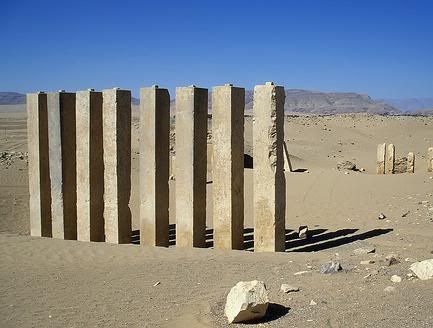
1. Mahram Bilqis, Yemen

This mysterious ruin is found in Yemen and is almost entirely covered with sand. According to legends, this holy site is attributed to the Biblical Queen of Sheba. The temple is surrounded by a wall of 260 metres length which is about 3-5 metres thick and may have once reached about 16 metres.

In the hall of the temple there are still a few of the 32 pillars that once supported the roof. The 8 monumental pillars that seem to watch the site as fierce guards look like as they have been casted as concrete.

Archaeologists have dated the site to 1500 – 1200 BC and possible older, definitely older than the times of Solomon and the Queen of Sheba.


[The Queen of Sheba]

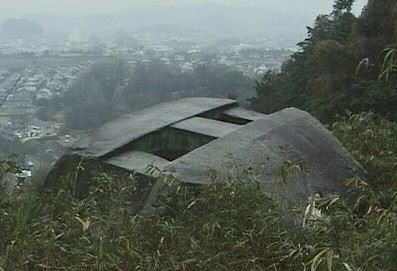
2. Masuda boulder, Japan

This mysterious boulder is found near Masuka Lake in Japan. It seems to have been thrown from heaven. It is strange because of its unusual shape: it contains two large square holes. The boulder is about 11 meters in length, 8 meters wide and about 4.7 meters high. The upper surface is smooth and some lower parts show signs of possible carving techniques.

The location and purpose of this boulder remains a mystery. The squares have flat surfaces and sharp corners, the construction of which requires the same technological abilities used in Egypt or South-America.

This Masuda boulder is another example of inimitable technology: applied in an inaccessible remote place, and apparently without any clear purpose.


[The Mystery of Masuda]

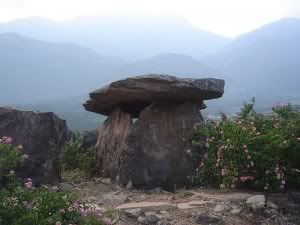
3. Marayoor Dolmens, India

Numerous dolmens can be found in Marayoor, India. The dolmens usually consist of 4 standing stones and a cap stone on top of them. All dolmens are made of hard granite.

Some of the stones are so neatly dressed that it is believed that they originate from the Iron Age while the less sophisticated worked stones are believed to be from the Stone Age.

During the Stone Age, the same types of dolmens were built in very remote regions like Western Europe, the Caucasus, Korea and India. Did the inhabitants of these regions invent the same idea, or did they have mutual contacts?


[Marayur dolmens losing the battle with time]

4. Nan Madol, New Guinea

Strange ruins of basalt pillars are to be found on the island of Pohnpei which is located at about 2000 km to the north-east of New Guinea. Some of the constructions are positioned in the water and an underwater tunnel connects a building with the sea which indicates that the site much be extremely old. According to historians, the site was erected around 1250 AD.

250 million tons of basalt logs were estimated to have been used to construct the whole city. The exact details of how this was done remain unknown. Each basalt log could have weighed around 50 tons. Furthermore, all of these were done on water.


[The Mystery Behind the Ancient Stone City of Nan Madol]

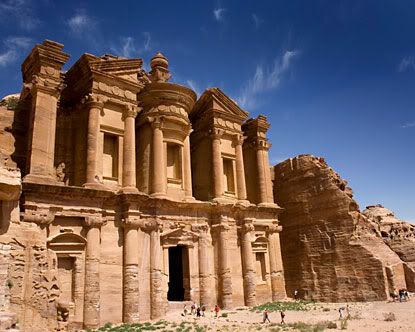
5. Petra, Jordan

Petra is a city in Jordan without houses but made up of only temples and tombs which all have been hewn from the rocks. It is not easy to reach this city since its access is very narrow. The light from the afternoon sun gives the red sand stone a unique appearance. The city was supposedly founded by the Nabateans, hundreds of years before Christ.

The top of this mountain was carved and cut by at least 7 metres, resulting in two remarkably tapering pillars. The purpose of building these pillars and their functions remain a mystery till today.


[The Ancient City of Petra in Jordan]

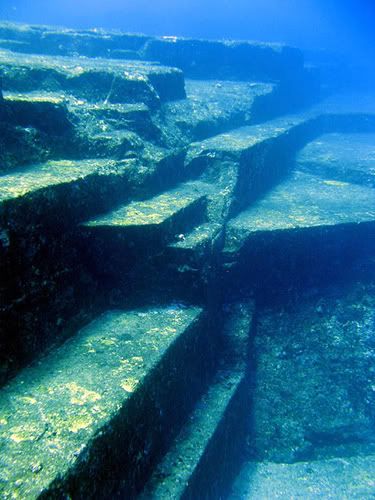
6. Yonaguni, Japan

Yonaguni is an underwater ziggurat type of construction, about 30 meters beneath the water surface. Yonaguni is a Japanese island near Okinawa and Taiwan.

It is a 5 layer platform hewn out of the bedrock, having straight planes and precisely defined sharp angles. It is about 200 meter wide and 30 meter high. Since it is 30 meters below sea level it is at least 10000 years old since in that time the sea level was - because of the melting of the icecaps at the end of the ice age; at a lower level than now.

This means that the structure is one of the oldest buildings in the world - together with the Sphinx in Egypt and Tihuanacu in Bolivia. Its exact purpose and origins still remains a mystery.


[The Mystery at Yonaguni]

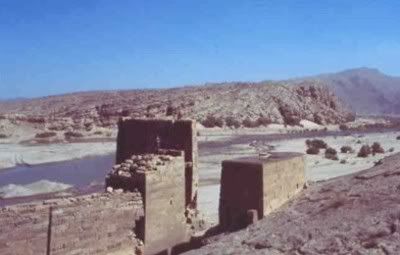
7. Marib Dam, Yemen

The Marib Dam is in the north of Yemen, about 120 km to the east of Sana’a. Archaeologists have discovered that the first dam started back in 2000 BC, though many repairs and rebuilding occurred in later times.


Today, only the north side and south side, together with spillway channels and sluices remains. The dam has a width of about 580 meters, was originally 4 meters and later 16 meters in height, which initiated the irrigation of a wide area.
The ancient peoples manage to build a massive dam strong enough to withstand the enormous water mass without cement. Till date, how this was achieved remains a mystery.


[Marib Dam - Yemen]


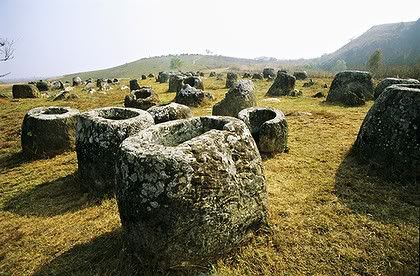
8. The Plain of Jars, Laos

This mysterious plain found in Laos contains thousands of megalithic jars. These stone jars appear in clusters, ranging from a single or a few to several hundred jars at lower foothills surrounding the central plain and upland valleys.

Till today, their exact purpose and origins are still unknown. Local legends tell of an ancient king who defeated a race of giants. To celebrate his victory, he ordered the jars created to brew and store large amounts of Lao wine.


[Ancient Mystery of Plain of Jars]


9. Mehrgarh, Pakistan

This ancient ruined city was discovered in 1921 in Pakistan. It is estimated to date back to the 7th to 8th millennium BC, making it almost 9000 years old. If this was accurate, the entire concept of the Indus Civilization will be changed.

The city consists of a great public bath, upstairs bathrooms in houses and covered sewers. Such technological advances were near impossible to replicate during such ancient times.


[Mehrgarh, Pakistan: Discovery of a 9000-Year-Old Civilized Settlement]

10. Piri Reis Map, Turkey

This map was discovered in 1929 in Turkey, and was determined to be created by Ottoman-Turkish admiral Piri Reis in 1513.

The remaining half of the map that survived shows the western coasts of Europe and North Africa and the eastern coast of Brazil with surprising accuracy. Various Atlantic islands including the Azores and Canary Islands are also depicted. Some claim that the map also depicts Japan.

Some claims this map supports a theory of global exploration by a pre-classical undiscovered civilization, supported by the amazing accuracy of this map. Others claim that this map was merely created by combining a set of different maps.


[The Piri Reis Map]

Some pictures and text in this article are granted permission to copy, distribute and/or modify this document under the terms of the GNU Free Documentation License, Version 1.2 or any later version published by the Free Software Foundation; and as such are reproduced in this article.

Read more >>

Sunday, October 9, 2011

10 Ancient Mysteries of Asia (Part 1)

by Joan Seth (joanseth77@gmail.com)

Our planet Earth has existed for about 4.5 billions of years, while humans have only existed for a few thousand years. But there are still a lot of things that we humans do not know about our past.

In this article, we take a look at some mysterious ancient structures and artifacts, whereupon we ask ourselves these questions: Where did ancient man obtain advanced knowledge? Where has this knowledge gone to? Did a deity or extraterrestrials give ancient man a helping hand?

1. Baalbek, Lebanon

Baalbek in Lebanon is one of the most mysterious places on earth. Ancient builders crafted the largest and heaviest stones on earth. There are blocks of about 10 metres long, 5 metres high and 3–4 metres deep. They weigh more than 450 tons each. At least 24 blocks have been discovered.

There are 3 even bigger blocks above these megaliths, weighing approximately 1000 tons each.

The mystery here is that even today, hardly any machinery exists to transport, lift and position such enormous blocks in such a restricted area. And of course, it is unimaginable that in ancient times people could have done this with manpower and ropes.
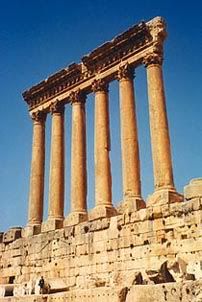


[The Mystery of Baalbek]

2. The Baghdad Battery, Iran

This object was unearthed at Khuyut in 1936. This mysterious object was estimated to date from a period between a few hundred years BC to some hundreds of years AD.

The Baghdad Battery is about 15 cm high with a lid of asphalt and an oxidised iron rod in the middle, surrounded by a 9 cm copper cylinder with a diameter of about 26 mm. When the vase is filled with an electrolyte, such as lemon juice or vinegar, it is able to deliver an electrical charge of approximately 1 volt.

It is however too small to provide any reasonable power. Dozens of these batteries would have to be connected. Furthermore, the similarity to the first batteries invented in 1867 is striking.
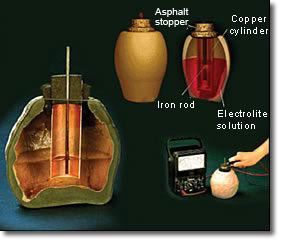


[The Baghdad Battery]

3. Borsippa, Iraq

In ancient times Borsippa or ‘Birs Numrud’ was the location of the Ezida temple, which was devoted to the god Marduk and in earlier times to the god Nabu.

The south westerly mound, the Birs proper, is probably the most conspicuous and striking ruin in all of Iraq. It is split down the centre and surrounded by huge masses of vitrified brick. Single enamelled bricks, most bearing an inscription of Nebuchadnezzar are also found around the site. They are twisted, curled and broken, as if damaged by great heat.

The mystery here is the intensity of the destruction since vitrified bricks can only be created by heat exceeding 1100 degrees Celsius in open air, which is impossible to achieve using standard means.

The only known vitrification in the open has resulted from nuclear explosions or impacts of comets. The latter can be ruled out in the case of Borsippa. The general belief is that lightning caused the vitrification, a theory which has proven to be impossible.
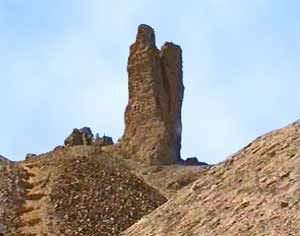


[The Mystery of Borsippa]

4. Candi Sukuh, Indonesia

The Candi Sukuh pyramid is located on the island of Java in Indonesia. It is the only pyramid on the Indonesian archipelago. Each stone in the pyramid has been tailor made. The pyramid would have been built in or around 1430 according to archaeologists.

The pyramid was mysteriously built using the same architectural techniques as per the pyramids in Mexico and Guatemala. Could these same techniques somehow managed to travel across the ocean thousands of kilometres apart and applied by people in different countries and cultures?
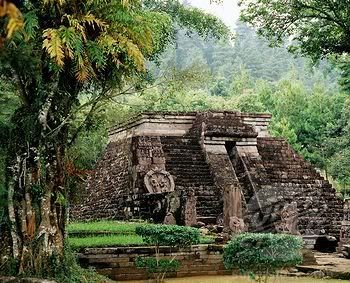


[Sukuh Temple is still A mystery]

5. Catal Hüyük, Turkey

Catal Hüyük existed from about 7250 BC till about 5600 BC. It is located in the central part of Turkey and was discovered by locals in 1958.

There are no streets; the houses were built one against the other. The only entrance was from above. In course of time, deteriorating houses were broken down and on top of the layer of rubble new houses were erected.

The larger rooms were plastered with white chalk and used for living; the smaller ones were stores. There were no buildings for governing or other public duties. It is a mystery why the entrances to the houses were only on the roof of the houses.
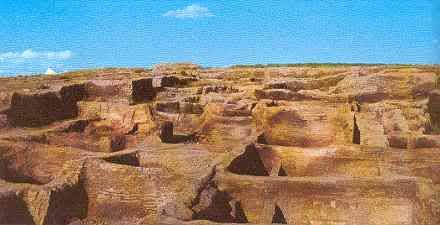


[The Religion of Catal Huyuk]

6. Chinese Pyramids, China

The existence of pyramids in China was discovered during the Second World War by an American pilot named Gaussmann.

In the area to the north of the city of Xian, there are about 25 pyramids. The biggest of these is near the famous ‘Terracotta Army’ and with a base of 350 x 370 metres is significantly larger than the Great Pyramid in Egypt. It is still smaller than the largest pyramid in the world, the Cholula pyramid in Mexico.
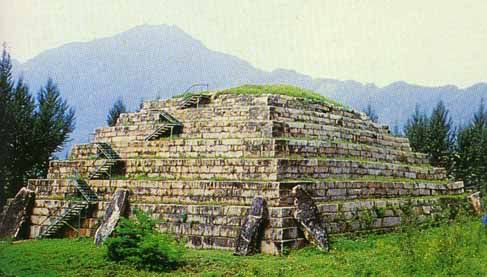


[China’s Great Pyramids Controversy]

7. Göbekli Tepe, Turkey

This is one of the oldest temples in the world. In the vicinity of the little town of Sanliurfa near the Syrian border, there is an archaeological excavation, Göbekli Tepe, which consists of a number of circular buildings which are made of limestone blocks that weigh several thousand kilograms each.

The structures date back to 9500 BC. Many of the stone circles have yet to be excavated, but the few that have been brought to light have diameters of up to 30 metres and the stones are decorated with reliefs of animals. There is no evidence of habitation and no consumer goods have been found which suggests that the site is an early temple.

The mystery in question is how it is possible that in a scarcely populated world, a world where mankind lived in a primitive manner, such a sophisticated building for which a high level of organisation would have been required could have been constructed.
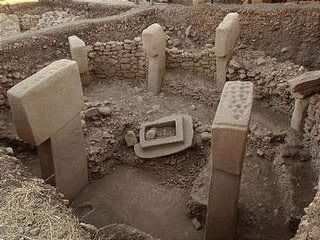


[World’s First Known Religious Temple at Göbekli Tepe]

8. Jericho, Palestine

Jericho, located at Tell es-Sultan is believed to be the oldest city in the World. The earliest human habitation took place in about 9000 BC, though the first permanent settlers came in 8000-7000 BC. The site then consisted of a few walls and a tower, and measures about 40 hectares.

The development of cities is strongly related to the invention and development of agriculture which enabled the establishment of larger populations. However, mysteriously, the construction of Jericho predates the invention of agriculture. It is likewise a mystery why the city needed walls. Who could be an enemy in a rather empty world?
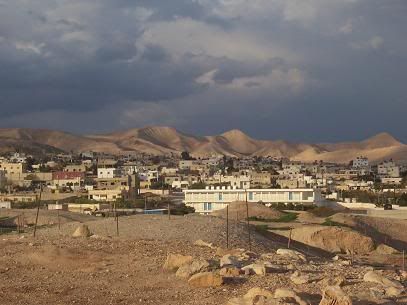


[Mystery of Ancient Jericho Monument Revealed]

9. Korean Dolmens, Korea

More than 40% of the world's dolmens are found in Korea. It is believed that they date back from the seventh century BC to around the third century BC.

There are two main types of dolmens. The table type, where a flat stone is supported by three or four standing stones. In the second type, the supportive stones are partially underground.

The great similarity to dolmens in Ireland, the United Kingdom and France suggests transatlantic contact during ancient times. Till date, their exact purpose still remains a mystery.
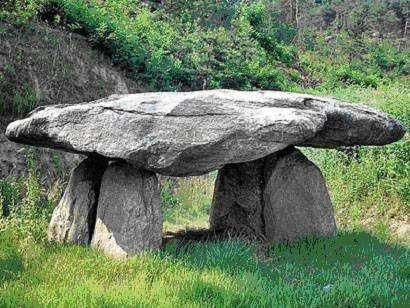


[History mystery: Dolmens stone formation]

10. Madain Salleh, Saudi Arabia

Madain Salleh is a city in Saudi Arabia. It is a sister city of Petra, built by the Nabateans more than 2000 years ago.

This mysterious city does not contain any houses, but it is actually made up of only temples and tombs which all have been hewn from the rocks. The site is about 13 km long.
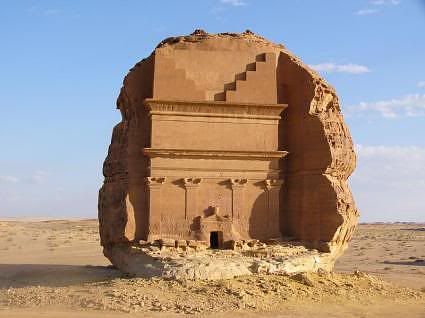


[The Mystery of Madain Saleh]

Some pictures and text in this article are granted permission to copy, distribute and/or modify this document under the terms of the GNU Free Documentation License, Version 1.2 or any later version published by the Free Software Foundation; and as such are reproduced in this article.

Read more >>

Sunday, September 25, 2011

Riddle in the sands: Thousands of strange 'Nazca Lines' discovered in the Middle East

By TED THORNHILL

Peru’s Nazca Lines, the mysterious geoglyphs etched into the desert centuries ago by indigenous groups, are world famous – and now thousands of similar patterns have been found in the Middle East.

Satellite and aerial photography has revealed mysterious stone ‘wheels’ that are more numerous and older than the Nazca Lines in countries such as Syria, Saudi Arabia and Jordan.

The structures are thought to date back 2,000 years, but why they were built is baffling archaeologists and historians.

‘In Jordan alone we've got stone-built structures that are far more numerous than the Nazca Lines, far more extensive in the area that they cover, and far older,’ David Kennedy, a professor of classics and ancient history at the University of Western Australia, told Live Science.

He added: ‘People have probably walked over them, walked past them, for centuries, millennia, without having any clear idea what the shape was.’

The local Bedouin, a nomadic people found in Saudi Arabia, Jordan, Libya, Egypt and Israel, call them the ‘works of the old men’.

They are often found on lava fields – but don’t fall into any pattern, according to Kennedy, whose research into them will be published in an upcoming issue of the Journal Of Archaeological Science.

He explains that they come in a huge variety of forms, some being ‘kites’, structures that funnelled animals, some being seemingly random meandering lines of stone and others being rectangular.

None are believed to be aligned with the stars, which has added to the mystery surrounding their purpose.

They were actually first discovered in 1927 by an RAF pilot called Lt. Percy Maitland, but it wasn’t until Professor Kennedy and his team began studying aerial and Google Earth photographs that their true extent was revealed.

A final count has yet to be completed, but Kennedy is certain they run into the thousands.

[Click here to read full article]

[Gallery of images]
Read more >>

Wednesday, September 21, 2011

The Ancient Mystery of the ‘Plain Of Jars'


Maybe you noticed already, that I’m a fan of Laos. This has a number of reasons, one being, that Laos is today, what Thailand was 20 years ago. It’s a laid-back secluded country, with lot’s of mysteries, unique activities and quirky originalities.`

Can you imagine a place on earth, where huge stone jars are scattered on a giant plain; like the Gods just stood up from their meal and left all their pots and containers lie around? This is how it looks in a secret place in Laos - welcome to the ‘Plain of Jars’:

The Plain of Jars is an historic cultural site in Laos, containing thousands of enormous stone or clay jars, which lie scattered throughout the Xieng Khouang plain in the Laotian Highlands at the northern end of the Annamese Cordillera, the principal mountain range of Indochina.

Lao stories and legends claim that there was a race of giants who once inhabited the area. Local legend tells of an ancient king called Khun Cheung, who fought a long, victorious battle against his enemy. He supposedly created the jars to brew and store huge amounts of lao lao rice wine to celebrate his victory.

Although there is no scientific explanation as to how these jars found their way onto the plain, nor what purpose they served, Archaeologists have come up with the wildest theories, among them a claim declaring them brewery cauldrons.

Other say, the jars are enormous urns, around 2,000 years old. There is speculation again, that the plain was at the connection point of old Caravan Routes coming from India and the jars were simply unloaded here, but forgotten in time.
Read more >>

Monday, September 19, 2011

The Vimanas - The Ancient Flying Machines

There are reference to flying machines in the temple carvings and in the ancient writings.

The images found on the ceiling beams of a 3000-year old New Kingdom Temple, located several hundred miles south of Cairo and the Giza Plateau, at Abydos resembles modern day Aircrafts.


Reference to ancient Indian flying vehicles comes from ancient Indian sources, many are the well known ancient Indian Epics, and there are literally hundreds of them. Most of them have not even been translated into English yet from the old sanskrit.

It is claimed that a few years ago, the Chinese discovered some sanskrit documents in Lhasa, Tibet and sent them to the University of Chandrigarh to be translated. Dr. Ruth Reyna of the University said recently that the documents contain directions for building interstellar spaceships!

Their method of propulsion, she said, was "anti-gravitational" and was based upon a system analogous to that of "laghima," the unknown power of the ego existing in man’s physiological makeup, "a centrifugal force strong enough to counteract all gravitational pull."

According to Hindu Yogis, it is this "laghima" which enables a person to levitate. Dr. Reyna said that on board these machines, which were called "Astras" by the text, the ancient Indians could have sent a detachment of men onto any planet, according to the document, which is thought to be thousands of years old. The manuscripts were also said to reveal the secret of "antima", "the cap of invisibility" and "garima", "how to become as heavy as a mountain of lead."

[Click here to read full article]
Read more >>

Thursday, September 8, 2011

The Dropa Stones

THE GRAY OVERCAST sky hung low in the isolated valley on the cool autumn afternoon. The surrounding mountain peaks had been masked by the heavy clouds for days. A deep rumble shook the ground, sending animals scurrying and startling birds from their roosts in the trees. The thunder-like rumbling from above the clouds grew louder. The valley had never heard thunder like this. The rumbling intensified to a heavy roar.

A small group of hunters stalking deer cast their eyes to the sky, expecting the clouds to break open from the deafening thunder with a torrent of rain. But this wasn't thunder at all. A bright flash burst forth from the ceiling of clouds. The hunters realized this was not lightning. They had never seen anything like this before. A glowing orb streaked through the sky above their heads as they watched in dazed disbelief. The orb wobbled and veered as it fell, as if it were trying to fight gravity and keep itself from smashing into the ground.

The hunters readied their weapons, not knowing what threat this mystery from the sky might present. Suddenly the thundering roar stopped, and the orb made one final veer and a slight upward turn before slamming into the earth. The hunters were nearly knocked off their feet from the shockwave. The thing - whatever it was - hit the ground just beyond a line of trees, perhaps an hour's walk away, the hunters estimated.

[Click here to read full article]
Read more >>

Tuesday, September 6, 2011

Mystery of Black Mesa Intrigues Archaeologists

The latest mystery of the Black Mesa, an eerie mountain of lava In the Oklahoma Panhandle, is stirring new interest among professional and amateur archaeologists.

Four states — Colorado, Kansas, New Mexico and Texas —corner near Black Mesa, which has yielded many relics of the ancient past, including the remains of dinosaurs and hairy mammoths.

But the newest find by R.Truman Tucker, 70-year-old retired rancher who has tramped the area all of his life, is mind-boggling in its possible scope.

Tucker has found what he believes to be human footprints in what looks like Dakota Sandstone, a cretaceous formation laid down during the age of dinosaurs. That, of course, is considered impossible by archaeologists and geologists who set man’s existence millions of years after the dinosaur age.

[Click here to read full article]
Read more >>

Thursday, August 4, 2011

Explorers find bizarre, spaceship-like object at the bottom of the Baltic Sea

Several days ago, we reported that a Swedish team of shipwreck hunters discovered a strange, circular object at the bottom of the Baltic Sea that looks sort of like the Millennium Falcon. The group was using sonar to plumb the depths of the waters, hoping to find shipwrecks that might contain treasures they could sell. The Ocean Explorer team isn't sure what to make of this strange discovery that some are calling a crashed UFO, but they've released more information about it.

Here you can see Peter Lindberg, from the Swedish Ocean Explorer team that discovered the object, explaining what they found. Earlier, he told reporters:

At 87 meters down, between Sweden and Finland, they saw a large circle, about 60 feet in diameter. You see a lot of wierd stuff in this job but during my 18 years as a professional I have never seen anything like this. The shape is completly round…a circle.

[Click here to read full article]
Read more >>

Friday, July 8, 2011

Dogu statues

These Japanese Dogu statues were made by the Jorom people and dated to about 5000 BC. They can be found in the Japan Archaeological Collection of Tohoku University, Sendai. These statues are one of those anomalies that, if you really want to look with an open mind, will bring you volumes to read written by people who are convinced these are beings in pressurized suits and even those who believe they have "translated" the designs on them; they can be correlated to actual mechanical and technical equipment as we know it today. Tightly cuffed armbands, mouth filters, pressurized suits, eye wear to see in our atmosphere, shoulder pads, gloves, equipment?

For basic starters, the figures are wearing goggles which were unknown then. Not only are they goggles with a tiny slit in them, but we're talking some serious eyewear equipment here. Sitting on a face that doesn't really look very human. They have four fingers. Compared to the other statues/art made at this time, they are much more advanced and detailed.

[Click here to read full article]
Read more >>

Tuesday, March 15, 2011

Mysterious Huge Stone Eggs Discovered in Hunan Province


Apr 17, 2007

A large number of "stone eggs" were recently discovered along with a copper sword at a construction site in Bandeng Hill and Zhanlong Hill, Gongxi Town of Hunan Province. The discoveries were made by highway construction workers while they were digging the foundation for a road.

The origin of the stone eggs is currently unknown as it is reported that further analysis by experts will be required to determine what they are and where they came from.

The construction workers said that Bandeng Hill is quite simply a stone-egg mountain. They found multiple nests of unique stone eggs throughout the course of digging the road's foundation. The eggs are oval in shape, with a wide range of sizes; the smallest one being no bigger than a water melon, while the largest is reported as being the size of a big table. Upon closer examination they look like eggs from the outside, but are very shiny and black on the inside.

[Click here to read full article]
Read more >>

Monday, March 14, 2011

Ancient Jade Discs

Mysterious ancient discs made from nephrite jade discovered in China (2005) are raising scientific eyebrows in China and elsewhere. Among the earliest surviving Chinese artifacts, the discs are called ‘Bi’ and have been associated by some scholars with the Shang Dynasty (16th-11th century B.C.); however, they may be much older, representing neolithic art from 6000 to 2000 B.C. Showing clear evidence of advanced precision tooling, though, the ‘Bi’ discs present scientists with an unexplainable anomaly.

It is difficult, if not impossible, to imagine how they could have been made with the primitive stone tools and abrasives usually associated with the period. The original function and significance of the bi are unknown, as the Neolithic cultures have left no written history.

From these earliest times they were buried with the dead, as a sky symbol, accompanying the dead into the after world or "sky", with the cong which connected the body with the earth.They were placed ceremonially on the body in the grave of persons of high social status.

[Click here to read full article]
Read more >>

Wednesday, February 2, 2011

Astronaut carving on a cathedral built 1100 years ago


Inside the splendid Ieronimus Cathedral, built by Episcope de Salamanca in 1102 A.D., among the fascinating carvings of mythical animals and saints, we find – NASA Astronaut…

Maybe they entered some time portal while on the Moon, and ended up scaring medieval builders in Spain? Probably just a modern addition by the mischievous restoration team.
Read more >>
 
Asia Paranormal Google Page Rank
AsiaParanormal Blogger Template "Sleek 2" Designed by HypeSeek © 2012