A personal message from Oregon Chang

Have you had a close encounter story or witnessed something unusual that you would like to share?

Do you wish to collaborate with Asia Paranormal through link or content exchange?

Do you have any enquiries or feedback?

Email us at AsiaParanormal@gmail.com

We look forward to hearing from you!

Follow us on Subscribe Asia Paranormal in your favorite reader. Follow Asia Paranormal in Facebook. Follow Asia Paranormal in Twitter. Follow Asia Paranormal Youtube channel.

Vote for us! We are listed at the www.topparanormalsites.com website. Click here to vote for us.. Thank you :-)

Best regards, on behalf of team AsiaParanormal

Master Orthodox Occultist Oregon Chang, The 17th generation Disciple of Seven Stars Sword Master Hebei China

Showing posts with label Science and Technology. Show all posts

Friday, December 28, 2012

When will the world really end?


Billions of years from now, life on Earth will be extinguished when the dying sun scorches the surface of our planet. New research has aimed to determine what the last life forms on Earth will be, and what kind of abodes they will cling to before the Earth becomes sterilized.
We are fortunate that our planet orbits a star that has a long main-sequence lifetime. However, the sun’s luminosity is gradually increasing, and in about one billion years the effects of this will start to be felt on Earth.
Surface temperatures will start to creep relentlessly upwards over the next few billion years, which will increase the amount of water vapor in the air. This will act to further increase temperatures and will thus signify the beginning of the end for life on Earth.
The rising temperatures will cause excessive amounts of rain and wind, and thus increase the weathering of silicate rocks, which will suck extra carbon from the atmosphere.
Ordinarily, the carbon is replaced via plate tectonics in the carbon-silicate cycle as it is released in volcanic gases. However, the oceans will start to evaporate as the temperatures continue to rise, which will probably put a stop to plate tectonics as scientists believe that water is an essential lubricant for the motion of tectonic plates on Earth. This will deplete the number of active volcanoes, and the carbon will not be replenished in the atmosphere.
The lack of carbon dioxide will effectively choke plant life on Earth, since plants require atmospheric CO2 for their respiration. The death of oxygen-producing plants will in turn lead to less oxygen in the atmosphere over a few million years. This will spell disaster for the remaining animal life on Earth, with mammals and birds being the first to become extinct. Fish, amphibians and reptiles would survive a little longer, as they need less oxygen and have a greater tolerance to heat.
The last type of animal present on the far-future Earth would likely be invertebrates. Once the insects finally succumb to the increasing temperatures, the Earth will once again be solely populated by microbial life, just as it had been for the first few billion years of our planet’s history. The last lingering life will desperately seek out niches of the planet that are still habitable, but even extremophile forms of life will find this to be a challenge.


[Click here to read full article]
Read more >>

Friday, October 19, 2012

Ancient Asian Wonders of the World (Pretra of Jordan )

Why and what makes Preta an ancient Asian wonder of the world ?
view videos as follows :


Petra Jordan one of the new world wonders, and rightfully so. Enjoy this spectacular rose red ancient city. The Treasury and Monastery Mysterious lands mythical locations paranormal activity ufo sighting ghost sighting Archaeologic site in Jordan famous for its many stone structures carved in rock. Re-discovered in 1812 by the Swiss explorer Johann Burckhardt, Petra was the capital of the ancient Nabateans and was the center of their caravan trade. They controlled the flow of water to the city creating a natural oasis


Al Khazneh, one of the ancient world's most magnificent ancient megastructures which humans display formidable resourcefulness and courageous endeavour to create. It was generally believed to be built between 100 BC and 200 AD. Petra is a historic and archaeological city in the Jordanian governorate of Ma'an that has rock cut architecture and water conduits system. Established sometime around the 6th century BC as the capital city of the Nabataeans, it is a symbol of Jordan as well as its most visited tourism attraction. It lies on the slope of Mount Hor in a basin among the mountains which form the eastern flank of Arabah, the large valley running from the Dead Sea to the Gulf of Aqaba. Petra was chosen as one of the New Seven Wonders of the World in July 7, 2007 and a World Heritage Site since 1985. Petra was chosen by the BBC as one of "the 40 places you have to see before you die". The site remained unknown to the Western world until 1812, when it was introduced by Swiss explorer Johann Ludwig Burckhardt. Stations 19 through 26 of the stations list of Exodus are places associated with Petra. (The stations list is the list of the 42 Stations or Mansions visited by the Israelites following their exodus from Egypt as described in the Bible). This part of the country was Biblically assigned to the Horites, the predecessors of the Edomites.

Read more >>

Thursday, October 18, 2012

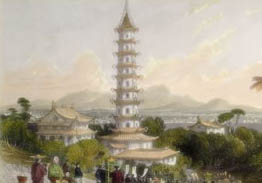
Ancient Asian Wonders of the World ( Porcelain Tower of Nanjing 南京陶塔 )


The Porcelain tower of Nanjing, also known as the Temple of Gratitude, is one of the marvels that appears on the list of the Seven medieval wonders of the world. This great construction was the highest building in China at the time of its construction and was set to dominate the banks of the River Yangtze for over 400 years before it met its grisly end. The porcelain tower of Nanjing was one of the most breathtaking constructions of its time and truly deserves its place in the 7 wonders of the medieval world category.


[Click here to read full article]
Read more >>

Wednesday, October 17, 2012

Ancient Asian Wonders of the World ( Great Wall )

Why and what makes the Great wall of China a Wonder of Ancient Asia ?

Please view videos :

The Great Wall of China is a series of stone and earthen fortifications in northern China, built, rebuilt, and maintained between the 5th century BC and the 16th century to protect the northern borders of the Chinese Empire. Since the 5th century BC, several walls have been built that were referred to as the Great Wall. One of the most famous is the wall built between 220206 BC by the first Emperor of China, Qin Shi Huang. Little of that wall remains; the majority of the existing wall were built during the Ming Dynasty.

The Great Wall stretches from Shanhaiguan in the east to Lop Nur in the west, along an arc that roughly delineates the southern edge of Inner Mongolia. The most comprehensive archaeological survey, using advanced technologies, has recently concluded that the entire Great Wall, with all of its branches, stretches for 8,851.8 km (5,500.3 mi). This is made up of 6,259.6 km (3,889.5 mi) of sections of actual wall, 359.7 km (223.5 mi) of trenches and 2,232.5 km (1,387.2 mi) of natural defensive barriers such as hills and rivers.


Read more >>

Monday, October 15, 2012

Ancient Asian Wonders of the World ( Taj Mahal)

What and why makes the Taj Mahal an ancient Asian wonder of the world ?

Please view video as follows :

The Taj Mahal (also "the Taj"), located in Agra, is considered the finest example of Mughal architecture, a style that combines elements from Persian, Turkish, Indian, and Islamic architectural styles. The focus of the Taj Mahal is the white marble tomb, which stands on a square plinth consisting of a symmetrical building with an iwan, an arch-shaped doorway, topped by a large dome. It was built by the Mughal emperor Shah Jahan (1628-1658), grandson of Akbar the great, in the memory of his queen Arjumand Bano Begum, entitled 'Mumtaz Mahal'. The plinth and tomb took roughly 12 years to complete. The remaining parts of the complex took an additional 10 years and were completed in order of minarets, mosque and jawab and gateway. A labour force of 20,000 workers was recruited across northern India.


The Taj Mahal was built on a parcel of land to the south of the walled city of Agra. Shah Jahan presented Maharajah Jai Singh with a large palace in the center of Agra in exchange for the land. An area of roughly three acres was excavated, filled with dirt to reduce seepage and leveled at 50 meters above riverbank. In the tomb area, wells were dug and filled with stone and rubble as the footings of the tomb. Instead of lashed bamboo, workmen constructed a colossal brick scaffold that mirrored the tomb. The scaffold was so enormous that foremen estimated it would take years to dismantle. According to the legend, Shah Jahan decreed that anyone could keep the bricks taken from the scaffold and thus was dismantled by peasants overnight. A fifteen kilometer tamped-earth ramp was built to transport marble and materials to the construction site. Teams of twenty or thirty oxen were strained to pull blocks on specially constructed wagons. An elaborate post-and-beam pulley system was used to raise the blocks into desired position. Water was drawn from the river by a series of purs, an animal-powered rope and bucket mechanism into a large storage tank and raised to large distribution tank. It was passed into three subsidiary tanks, from which it was piped to the complex.

The plinth and tomb took roughly 12 years to complete. The remaining parts of the complex took an additional 10 years and were completed in order of minarets, mosque and jawab and gateway. Since the complex was built in stages, discrepancies exist in completion dates due to differing opinions on "completion". For example, the mausoleum itself was essentially complete by 1643, but work continued on the rest of the complex. Estimates of the cost of the construction of Taj Mahal vary due to difficulties in estimating construction costs across time. The total cost of construction has been estimated to be about 32 million Rupees.

The Taj Mahal was constructed using materials from all over India and Asia. Over 1,000 elephants were used to transport building materials during the construction. The translucent white marble was brought from Rajasthan, the jasper from Punjab, jade and crystal from China. The turquoise was from Tibet and the Lapis lazuli from Afghanistan, while the sapphire came from Sri Lanka and the carnelian from Arabia. In all, twenty eight types of precious and semi-precious stones were inlaid into the white marble.

A labour force of twenty thousand workers was recruited across northern India. Sculptors from Bukhara, calligraphers from Syria and Persia, inlayer from southern India, stonecutters from Baluchistan, a specialist in building turrets, another who carved only marble flowers were part of the thirty-seven men who formed the creative unit. Some of the builders involved in construction of Taj Mahal are:

The main dome was designed by Ismail Afandi (a.k.a Ismail Khan),of the Ottoman Empire and was considered as a premier designer of hemispheres and domes.
Ustad Isa of Persia (Iran) and Isa Muhammad Effendi of Persia (Iran), trained by Koca Mimar Sinan Agha of Ottoman Empire, are frequently credited with a key role in the architectural design, but there is little evidence to support this claim.
'Puru' from Benarus, Persia (Iran) has been mentioned as a supervising architect.
Qazim Khan, a native of Lahore, cast the solid gold finial.
Chiranjilal, a lapidary from Delhi, was chosen as the chief sculptor and mosaicist.
Amanat Khan from Shiraz, Iran was the chief calligrapher. His name has been inscribed at the end of the inscription on the Taj Mahal gateway.
Muhammad Hanif was a supervisor of masons and Mir Abdul Karim and Mukkarimat Khan of Shiraz, Iran (Persia) handled finances and management of daily production.


Commissioned in 1632 by the Mughal emperor Shah Jahan to house the remains of his cherished wife, the Taj Mahal stands on the southern bank of the Yamuna River in Agra, India. The famed mausoleum complex, built over more than 20 years, is one of the most outstanding examples of Mughal architecture, which combined Indian, Persian and Islamic influences. At its center is the Taj Mahal itself, built of shimmering white marble that seems to change color depending on the sunlight or moonlight hitting its surface. Designated a UNESCO World Heritage site in 1983, it remains one of the world's most celebrated structures and a stunning symbol of India's rich history.

Taj Mahal: Shah Jahan's Romantic Gesture
Shah Jahan was a member of the Mughal dynasty that ruled most of northern India from the early 16th to the mid 18th-century. After the death of his father, King Jahangir, in 1627, Shah Jahan emerged the victor of a bitter power struggle with his brothers, and crowned himself emperor at Agra in 1628. At his side was Arjumand Banu Begum, better known as Mumtaz Mahal ("Chosen One of the Palace"), whom he married in 1612 and cherished as the favorite of his three queens.

In 1631, Mumtaz Mahal died after giving birth to the couple's 14th child. The grieving Shah Jahan, known for commissioning a number of impressive structures throughout his reign, ordered the building of a magnificent mausoleum across the Yamuna River from his own royal palace at Agra. Construction began around 1632 and would continue for the next two decades. The chief architect was probably Ustad Ahmad Lahouri, an Indian of Persian descent who would later be credited with designing the Red Fort at Delhi. In all, more than 20,000 workers from India, Persia, Europe and the Ottoman Empire, along with some 1,000 elephants, were brought in to build the mausoleum complex.


Wonderfull documentary by National Geographic about the Taj Mahal, world's greatest and divine symbol of true love.


Read more >>

Sunday, October 14, 2012

Ancient Asian Wonders of the World ( Mausoleum at Halicarnassus )

why and what makes Mausoleum at Halicarnassus a wonder of ancient world of Asia in present day Turkey?

View the Video

The Mausoleum at Halicarnassus or Tomb of Mausolus (in Greek, Μαυσωλεῖον τῆς Ἁλικαρνασσοῦ) was a tomb built between 353 and 350 BC in the Greek colony of Halicarnassus for Mausolus, a satrap in the Persian Empire, and Artemisia II of Caria, his wife and sister. The structure was designed by the Greek architects Satyros and Pythis. It stood approximately 45 m (148 ft) in height, and each of the four sides was adorned with sculptural reliefs created by each one of four Greek sculptors — Leochares, Bryaxis, Scopas of Paros and Timotheus. The finished structure was considered to be such an aesthetic triumph that Antipater of Sidon identified it as one of his Seven Wonders of the Ancient World.


The Mausoleum of Halicarnassus:
The Mausoleum at Halicarnassus or Tomb of Mausolus (in Greek, Μαυσωλεῖον τῆς Ἁλικαρνασσοῦ) was a tomb built between 353 and 350 BC at Halicarnassus (present Bodrum, Turkey) for Mausolus, a satrap in the Persian Empire, and Artemisia II of Caria, his wife and sister. The structure was designed by the Greek architects Satyros and Pythius of Priene. The Mausoleum stood approximately 45 m (148 ft) in height, and each of the four sides was adorned with sculptural reliefs created by each one of four Greek sculptors — Leochares, Bryaxis, Scopas of Paros and Timotheus. The finished structure of the mauloseum was considered to be such an aesthetic triumph that Antipater of Sidon identified it as one of his Seven Wonders of the Ancient World.


Read more >>

Saturday, October 13, 2012

Ancient Asian Wonders of the World (Hagia Sophia)

Hagia Sophia was a legacy of the Byzantium (Roman Empire), the Eastern Roman Empire established in present day Turkey.

What and why makes this building a wonder ?

View the videos


Hagia Sophia-The legacy of Byzantium
Hagia Sophia Cathedral (Holy wisdom) was build up by two Greek architects Anthemius and Isidorus during the reign of Emperor Justinian.

Hagia Sophia (from the Greek: Ἁγία Σοφία, "Holy Wisdom"; Latin: Sancta Sophia or Sancta Sapientia; Turkish: Aya Sofya) is a former Orthodox patriarchal basilica, later a mosque, and now a museum in Istanbul, Turkey. From the date of its dedication in 360 until 1453, it served as the cathedral of Constantinople, except between 1204 and 1261, when it was converted to a Roman Catholic cathedral under the Latin Patriarch of Constantinople of the Western Crusader established Latin Empire. The building was a mosque from 29 May 1453 until 1934, when it was secularized. It was opened as a museum on 1 February 1935


Hagia Sophia (Άγια Σοφία in Greek), the Church of Holy Wisdom, known variously as Sancta Sophia in Latin or Ayasofya in Turkish, is an ancient cathedral of the Church of Constantinople located in modern-day Istanbul, Turkey. It was converted to a mosque by the Turks and is now used as a museum. It is universally acknowledged as one of the great buildings of the world and a reference point in history of architecture. (The church is sometimes mistakenly called "Saint Sophia," as though it were named for a saint called Sophia.)

The first great church on the site was built by Constantius II, the son of Constantine the Great, but was burned down during the Nika riots of 532. The building was rebuilt in its present form between 532 and 537 under the personal supervision of emperor Justinian the Great. It is one of the greatest surviving examples of Byzantine architecture. Of great artistic value was its decorated interior with mosaics and marble pillars and coverings. The temple itself was so richly and artistically decorated that Justinian is believed to have said Νενίκηκά σε Σολομών: "Solomon, I have surpassed you!"
Interior of Hagia Sophia

The architects of the church were Isidore of Miletus and Anthemius of Tralles, professors of geometry at the University of Constantinople. Justinian's basilica was at once the culminating architectural achievement of late antiquity and the first masterpiece of Byzantine architecture. Its influence, both architecturally and liturgically, was widespread and enduring in the Orthodox, Roman Catholic, and Muslim worlds alike.

Hagia Sophia is covered by a central dome with a diameter of 31 meters (102 feet), slightly smaller than the Pantheon's. The dome seems rendered weightless by the unbroken arcade of arched windows under it, which help flood the colorful interior with light. The dome is carried on pendentives: four concave triangular sections of masonry which solve the problem of setting the circular base of a dome on a rectangular base. In Hagia Sophia the weight of the dome passes through the pendentives to four massive piers at the corners. Between them the dome seems to float upon four great arches.

At the western (entrance) and eastern (liturgical) ends, the arched openings are extended by half domes carried on smaller semidomed exedras. Thus a hierarchy of dome-headed elements build up to create a vast oblong interior crowned by the main dome, a sequence unexampled in antiquity.

The structure has been severely damaged several times by earthquakes. The dome collapsed after an earthquake in 558; its replacement fell in 563. There were additional partial collapses in 989 and 1346.

All interior surfaces are sheathed with polychrome marbles, green and white with purple porphyry and gold mosaics, encrusted upon the brick. On the exterior, simple stuccoed walls reveal the clarity of massed vaults and dome.

For over 900 years the Hagia Sophia was the seat of the Patriarch of Constantinople and a principal setting for imperial ceremonies. It was converted to a mosque at the Fall of Constantinople to the Ottoman Turks under Sultan Mehmet II in 1453. Since Islam considers the depiction of the human form to be blasphemous— that is, it is iconoclastic—Hagia Sophia's iconographic mosaics were covered with plaster. For almost 500 years the principal mosque of Istanbul, Ayasofya, served as model for many of the Ottoman mosques of Constantinople such as the Shehzade Mosque, the Suleiman Mosque, and the Rustem Pasha Mosque.
Read more >>

Friday, October 12, 2012

Ancient Asian Wonders of the World ( Hanging Garden)

The Hanging Gardens are one of the Wonders of the World from the ancient world of the Asians of Babylonia , present day Iraq

Does it really exists , today ?
What makes it a Wonder and why ?

View the video below


The Hanging Gardens of Babylon are considered to be one of the original Seven Wonders of the Ancient World. They were built in the ancient city-state of Babylon, near present-day Al Hillah, Babil, in Iraq. They are sometimes called the Hanging Gardens of Semiramis (in reference to the legendary Queen Semiramis).

The gardens were supposedly built by the Babylonian king Nebuchadnezzar II around 600 BC. He is reported to have constructed the gardens to please his homesick wife, Amytis of Media, who longed for the trees and fragrant plants of her homeland Persia. The gardens were destroyed by several earthquakes after the second century BC.

View more links as below

http://www.youtube.com/watch?v=IIVw4JkXpY4&feature=share&list=LPLzYuJQeAoDY


http://www.youtube.com/watch?v=HDRze962yFU&feature=share&list=LPLzYuJQeAoDY

Read more >>

Thursday, October 11, 2012

Ancient Asian Wonders of the World ( AngKor Wat)

What truly makes this legendary and famous Historical Site, Angkor Wat of Cambodia a wonder of the world ?

Why is it consider as a wonder?
View video to learn more


How Khmer built Angkor that it is very wonderful temple in the world.
Angkor Wat  is a temple complex at Angkor, Cambodia, built by King Suryavarman II in the early 12th century as his state temple and capital city.


One of the best old ancient complex engineering structures on the world.
Before dying, here the place where we should see


There are two great complexes of ancient temples in Southeast Asia, one at Bagan in Burma, the other at Angkor in Cambodia. The temples of Angkor, built by the Khmer civilization between 802 and 1220 AD, represent one of humankind's most astonishing and enduring architectural achievements.

 From Angkor the Khmer kings ruled over a vast domain that reached from Vietnam to China to the Bay of Bengal. The structures one sees at Angkor today, more than 100 stone temples in all, are the surviving remains of a grand religious, social and administrative metropolis whose other buildings - palaces, public buildings, and houses - were built of wood and have long since decayed and disappeared


Angkor Wat is a temple complex at Angkor, Cambodia, built by King Suryavarman II in the early 12th century as his state temple and capital city. As the best-preserved temple at the site, it is the only one to have remained a significant religious centre since its foundation -- first Hindu, dedicated to the god Vishnu, then Buddhist. The temple is at the top of the high classical style of Khmer architecture.

Angkor Wat combines two basic plans of Khmer temple architecture: the temple mountain and the later galleried temple, based on early South Indian Hindu architecture, with key features such as the Jagati. It is designed to represent Mount Meru, home of the devas in Hindu mythology: within a moat and an outer wall 3.6 kilometres (2.2 mi) long are three rectangular galleries, each raised above the next. At the centre of the temple stands a quincunx of towers.

The initial design and construction of the temple took place in the first half of the 12th century, during the reign of Suryavarman II (ruled 1113 -- c. 1150). Dedicated to Vishnu, it was built as the king's state temple and capital city. In the late 13th century, Angkor Wat gradually moved from Hindu to Theravada Buddhist use, which continues to the present day.
Read more >>

Tuesday, July 3, 2012

What if Time Stops Completely?

What would happen to the universe if suddenly time stopped? Would it be exactly the way things were before time started? And can an abstract concept like time actually stop? Scientists Jose Senovilla, Marc Mars, and Raul Vera working from the University of Salamanca and University of Basque Country in Spain have proposed that there may be a day in our distant future where time will stop.

Imagine a world where all objects in motion simply froze with the landscape, thought was isolated, and everything was caught in a state of absolute stasis. Generally when we think about time slowing down and stopping, it's in the context of a universe where objects still exist, much like our own planet. But in this interpretation, time itself is dependent largely on external objects and forces in order to exist. It would essentially stop without anything to move it forward. And so as energy eventually dissipates, it will no longer be able to sustain a concept like time.

The scientists are examining evidence gathered from exploded stars, which appear to move much faster out at the edge of the universe than they do at the universe's center. This isn't groundbreaking when you take into account the theoretical form of matter known as "dark matter." With a name like dark matter, it has quite a bit to live up to in sci-fi spookiness and according to proponents of the existence of dark matter, it certainly does with forms of the matter actually making the existence of the universe possible according to many contemporary interpretations.

[Click here to read full article]
Read more >>

Wednesday, June 20, 2012

Zombie Cells Discovered that Survive Death

Researchers have made a discovery that may take zombie-phobes one step closer to revising their zombie apocalypse escape strategies. Researchers have found stem cells in cadavers that survived for more than 17 days. The incredible discovery has some potential for medical applications - and some people are wondering if this is going to enter into the dorm room zombie conversations on campuses around the nation.

There are few cells more interesting to researchers than stem cells. These incredible genetic blocks of life are capable of adapting to a number of different circumstances in order to repair damaged tissue, build muscle, and are a key component in creating larger more complex organisms. And now thanks to a study on stem cells conducted at the Pasteur Institute in Paris by Fabrice Chretien and colleagues has determined that the cells actually have more of a lifespan after death than previously thought.

Originally cells were credited with being able to survive for up to two days after the death of larger organisms. In humans, it was previously expected two days was likely the upper limit of how long a stem cell could survive after death. Stem cells are often difficult to find in adults, particularly after death. But the researchers sifted through several cadavers that were kept at temperatures just above freezing and were able to determine that the cells had actually entered a dormant state.

[Click here to read full article]
Read more >>

Saturday, June 9, 2012

The Nature of Time

Much of ancient Greek philosophy was concerned with understanding the concept of eternity, and the subject of time is central to all the world's religions and cultures. Can the flow of time be stopped or slowed? Certainly some mystics thought so. Angelus Silesius, a 17th-century philosopher and poet, thought the flow of time could be suspended by mental powers:

Time is of your own making;
its clock ticks in your head.
The moment you stop thought
time too stops dead.

The line between science and mysticism sometimes grows thin. Today physicists would agree that time is one of the strangest properties of our universe. In fact, there is a story circulating among scientists of an immigrant to America who has lost his watch. He walks up to a man on a New York street and asks, "Please, Sir, what is time?" The scientist replies, "I'm sorry, you'll have to ask a philosopher. I'm just a physicist."

Time travel, according to modern scientific theory, may still be beyond our grasp. Yet for a number of people who have had unusual time slip experiences, time may be easier to circumnavigate than expected.

A classic example of a time slip can be seen in a note from Lyn in Australia. Lyn had read the book, Time Travel: A How-To Insiders Guide, (Global Communications, 1999) and thought her experience was similar to others featured in the book.

In 1997 Lyn lived in a small outback town that was built in 1947 and had changed little since that time.

"I was driving toward the main intersection of the town, when suddenly I felt a change in the air. It wasn't the classic colder feeling, but a change, like a shift in atmosphere. The air felt denser somehow. As I slowed at the intersection, I seemed to be suddenly transported back in time to approximately 1950. The road was dirt, the trees were gone and coming toward me to cross the intersection was an old black car, something like a Vanguard or old FJ Holden. As the car passed through the intersection the driver was looking back at me in total astonishment before he accelerated. From what I could see he was dressed in similar 1950s fashion, complete with hat.

"This whole episode lasted perhaps 20 seconds and was repeated at least 5 times during my time there, always at the exact spot. I tried to make out the registration plate number but the car was covered in dust."

Lyn wondered if there is someone out there still living who remembers seeing a strange sight at the intersection back in the 50s...of a weird car with a bug-eyed woman at the wheel. 2

Derek E. tells another interesting time slip story. When he was a child, his father was a taxi driver in Glasgow, Scotland. One day in the late 1960s, Derek's father was driving in the north of the city along Maryhill Road near Queen's Cross, one of the older parts of town and once its own separate community outside the city.

"One minute it was now," Derek wrote, "cars, buses, modern clothes, tarmac roads etc. - and the next thing my dad knew he was in some earlier time. It was certainly pre-Victorian given the clothes he described people wearing, horses, rough road, lower buildings, people in rough clothes and bonnets etc. It lasted as long as it took him to be aware of it and then it vanished and he was back in 'now.'"

Derek also reported that in the 1980's, he and his wife were on a driving holiday in the North York Moors in England. They went to a tiny coastal village called Staithes, which had a steep winding and narrowing road down to the harbor, with the entrance to the houses and narrow footway at a higher level of three or four feet.

"We parked at the top of the village, hamlet really, where the tourist buses and cars had to stop and made our way down on foot. What I remember is a brilliantly sunny day with lots of other people around, but as we made our way down, it just suddenly seemed as if no one else were there but my wife and me. An old woman appeared on the footway opposite us. It became cooler and duller.

She asked, in what seemed to me an old-fashioned and very polite way, what year it was. Now lots of old people get confused and it could have been that, but what I remember vividly is her black clothes - handmade, rough and with hand-sewn buttons - really big compared with modern ones. Her shoes were very old fashioned with much higher and chunkier heels than you'd see an older person wearing nowadays. In the time it took me to turn to my wife and say, 'Did you see that?' she was gone. The sun was back and so were all the people. My wife had also seen the same old woman and felt the same chill." 3

Derek's experience seems strikingly similar to traditional ghost stories. Many ghost sightings are readily explained as individuals who appear out of their normal location or time; but often the ghost also seems to change the surroundings of the witness, giving the impression of a time slip. What is open to question is whether these are glimpses into another time or does the witness or the ghost actually travel in time? Perhaps it is simply different sides of the same coin.

Martin Jeffrey, co-editor with Louise Jeffrey of the website www.mysterymag.com, speculates that time slips can be recreated or induced using a "trigger factor," which "…occurs when one is interested in his surroundings but is not concentrating on them; a slip occurs at a precise place and moment and the witness is thrust seemingly into another time."

Jeffrey cites the case of Alice Pollock, who at Leeds Castle in Kent "experienced what could be called a 'classic' time slip. Alice was experimenting in Henry VIII's rooms by touching objects in an attempt to experience events from another time. After a period of receiving no impressions whatsoever, the room suddenly changed. It lost its modern, comfortable appearance to become cold and bare. The carpet had disappeared and there were now logs burning on the fire. A tall woman in a white dress was walking up and down the room; her face seemed to be in deep concentration. Not long after, the room returned to its original state.

Later research found that the rooms had been the prison of Queen Joan of Navarre, Henry V's stepmother, who had been accused of witchcraft by her husband. 4

It could be that the witness triggers time slips, whether they blank their mind at a precise moment and the slip occurs, or the witness touches something that holds the memory of a previous time.

"The simplest explanation is probably the psychometric hypothesis," noted Colin Wilson and John Grant in The Directory of Possibilities. "In the mid-nineteenth century, Dr. Joseph Rodes Buchanan of the Covington Medical Institute performed experiments that convinced him that certain of his students could hold letters in their hands and accurately describe the character of the writer. He became convinced that all objects carry their 'history' photographed in them. Buchanan wrote: 'The past is entombed in the present. The discoveries of psychometry will enable us to explore the history of Man as those of geology enable us to explore the history of Earth.' Clearly, psychometry may be seen as a form of time slip."

[Click here to read full article]
Read more >>

Saturday, May 19, 2012

Lawyer Claims Time Travel Coverup

Lawyer Andrew Basiago says he has a long history of traveling back in time, and he's been sharing his story with researchers the world over with his shocking allegations. In addition to speaking about subjects ranging from John Titor to his own witnessing of Lincoln's assassination, Basiago recently entered the news circuit once again after claiming that Barack Obama had once teleported to Mars in a secret CIA project operating out of a community college in California.

The Seattle Attorney says he was involved in a project when he was only seven years old called "Project Pegasus" to explore then recent developments in time traveling technology. His own involvement in the project, he says, was partially because children are more likely to adapt well to the effects of time travel. He additionally says the technology involved in the project is powerful enough to transform the face of transportation if only it would be unlocked.

The principles behind the time travel technology are allegedly based on tech recovered by government agents who raided the personal notes kept in the New Yorker hotel by Nikola Tesla where he died in July of 1943.

[Click here to read full article]
Read more >>

Friday, May 18, 2012

The Universe's Most Troubling Paradoxes

The universe seems like a chaotic place. Rules seem to guide a flow of random chances with even known universal laws occasionally overruling and rejecting one another. And on top of all of that the human race has put before itself the task of understanding everything. But somewhere along its journey it's come up with some extremely chilling theories about life the universe and everything.

Of course one of the first problems that arises when examining the universe is the Fermi Paradox. Contrary to the label often placed on the Paradox, there are no final conclusions to be drawn from it - only more questions. It was originally a response to the "silentium universi" or silence of the universe.

When Frank Drake of the University of California, Santa Cruz observed the potential for life existing elsewhere in the universe as very likely through a series of mathematical equations. The Fermi Paradox begged the question, "Why doesn't SETI observe more apparently artificial radio signals?" The conclusions are far from complete to say the least, but are nonetheless often erroneously used as evidence to suggest there is no life elsewhere in the universe.

[Click here to read full article]
Read more >>

Thursday, May 17, 2012

The Mystery of Time Slips

By Tim Swartz

Time is a funny thing. There never seems to be enough -- yet there is an infinite amount. Time slips through moment upon second into eternity past; yet present, to begin the future.

Time is thought to be unstoppable in its relentless push towards the future. Humans perceive themselves as bound up in time as an insect in amber. Forever imprisoned and forced to reconcile with the regularity and inevitability of change. The past is gone -- the present, fleeting -- and the future is unknown. Or is it?

If a Merseyside policeman by the name of Frank was asked, he may have an entirely different opinion on the subject of time.

On a sunny Saturday afternoon in July of 1996, Frank and his wife, Carol was visiting Liverpool's Bold Street area for some shopping. At Central Station, the pair split up; Carol went to Dillons Bookshop and Frank went to HMV to look for a CD he wanted. As he walked up the incline near the Lyceum Post Office/Café building that lead onto Bold Street, Frank suddenly noticed he had entered a strange "oasis of quietness."

Suddenly, a small box van that looked like something out of the 1950s sped across his path, honking its horn as it narrowly missed him. Frank noticed the name on the van's side: "Caplan's." When he looked down, the confused policeman saw that he was unexpectedly standing in the road. The off-duty policeman crossed the road and saw that Dillons Book Store now had "Cripps" over its entrances. More confused, he looked in to see not books, but women's handbags and shoes.

Looking around, Frank realized people were dressed in clothes that appeared to be from the 1940s. Suddenly, he spotted a young girl in her early 20's dressed in a lime-colored sleeveless top. The handbag she was carrying had a popular brand name on it, which reassured the policeman that maybe he was still partly in 1996. It was a paradox, but he was relieved, and he followed the girl into Cripps.

As the pair went inside, Frank watched in amazement as the interior of the building completely changed in a flash to that of Dillons Bookshop of 1996. The girl turned to leave and Frank lightly grasped the girl's arm to attract attention and said, "Did you see that?"

She replied, "Yeah! I thought it was a clothes shop. I was going to look around, but it's a bookshop."

It was later determined that Cripps and Caplan's were businesses based in Liverpool during the 1950s. Whether these businesses were based in the locations specified in the story has not been confirmed. 1

Frank's experience is not that unusual in the realm of strange phenomenon. There is even a name given to such events -- time slips.

A time slip is an event where it appears that some other era has briefly intruded on the present. A time slip seems to be spontaneous in nature and localization, but there are places on the planet that seem to be more prone than others to time slip events. As well, some people may be more inclined to experience time slips than others. If time then is the unmovable force that physicists say it is, why do some people have experiences that seem to flaunt this concept?

[Click here to read full article]
Read more >>

Tuesday, May 8, 2012

Could this virus cure cancer?

Australian scientists are leading a global charge to combat one of the world's worst killers with a surprising secret weapon - the common cold.

It's a tempting idea and one on the cutting edge of a new medical research field called oncolytic virotherapy. Could the common cold cure cancer?

Except that the idea is not really new at all. The classical Greek physician Hippocrates is often credited with the saying: ''Give me the power to create a fever and I shall cure any disease.''

More than 2500 years later modern scientists, including a team from the University of Newcastle, are proving the theory has merit.

Common viruses have become the latest weapon against cancer, with a small Australian biotechnology group one of the leaders in the field.

The idea has been around for some time. Not only did the classical Greeks make the observation but there have been a couple of instances of cancer patients entering spontaneous remission after exposure to certain viruses in the last century.

[Click here to read full article]
Read more >>

Monday, May 7, 2012

The Professor That Disproved Reality

Eventually, in the narrative of the artificial intelligence singularity, computers become so advanced that desktop PCs are able to process with incredible speed beyond the collective brain-power of every man, woman, and child who ever lived. And if this were the case, a proposal known as "simulation theory" suggests that the chances of being a product of one of these simulations is almost guaranteed. So how did one Oxford University Professor call everything in reality into question?

The paper at the center of the controversy is titled "Are You Living in a Computer Simulation?" Nick Bostrom, award winning Swedish Philosopher and professor may have come dangerously close to disproving reality as we know it. Circulated in 2003, the paper goes down the rabbit hole to suggest that we are not, as many have taken for granted, in a physical world governed by immutable laws that transcend the fabric of the universe dictated by forces unknown at its periphery.

Instead, it puts forward the following three possible scenarios given today's already emerging technological trends. First, it says it is quite possible that the human race will inevitably go extinct before it achieves a "posthuman" stage where artificial intelligence is able to improve upon itself in a Ray Kurzweil style AI singularity. If that is not the case, it suggests the idea that some factor in the human race's future will prevent more than a handful of advanced computer simulations of its own past from being built.

And the final scenario it puts forward is the most shocking of all - that we are currently living in an environment generated entirely by a computer. And that's not all. According to the paper, even our very minds may be simply byproducts of the computer simulation. It states that rather than a mere possibility, the likelihood of our being made from information is surprisingly high.

[Click here to read full article]
Read more >>

Monday, April 16, 2012

Has science explained life after death?

by Josh Clark

In 1991, Atlanta, Ga. resident Pam Reynolds had a near-death experience (NDE). Reynolds underwent surgery for a brain aneurysm, and the procedure required doctors to drain all the blood from her brain. Reynolds was kept literally brain-dead by the surgical team for a full 45 minutes. Despite being clinically dead, when Reynolds was resuscitated, she described some amazing things. She recounted experiences she had while dead -- like interacting with deceased relatives.

Even more amazing is that Reynolds was able to describe aspects of the surgical procedure, down to the bone saw that was used to remove part of her skull [source: Parker].
What's remarkable (although not unique) about Reynolds' experience is that it is the combination of an NDE and an out-of-body-experience (OBE). HowStuffWorks has braved this territory on the edge of reality, explaining how near-death experiences work and how a person can have an out-of-body experience. Science, too, has made its own headway toward explaining these weird phenomena. Two studies on the separate aspects of Reynolds' experience were conducted in 2007. Each seems to explain how a person can have an OBE or a NDE, but do they hold up in explaining experiences like Reynolds'? ­­

As many as 18 percent of people brought back from death after a heart attack said they'd had a NDE [source: Time]. While many religious adherents might not be surprised by these accounts, the idea that human consciousness and the body exist distinctly from each other flies in the face of science. A brain-dead person should not be able to form new memories -- he shouldn't have any consciousness at all, really.

So how can anything but a metaphysical explanation cover NDEs?
A study from the University of Kentucky has quickly gained ground among scientists as possibly the best explanation for NDEs. Researchers there theorize that the mysterious phenomenon is really an instance of the sleep disorder rapid eye movement (REM) intrusion. In this disorder, a person's mind can wake up before his body, and hallucinations and the feeling of being physically detached from his body can occur.

The Kentucky researchers believe that NDEs are actually REM intrusions triggered in the brain by traumatic events like cardiac arrest. If this is true, then this means the experiences of some people following near-death are confusion from suddenly and unexpectedly entering a dream-like state.

This theory helps explain what has always been a tantalizing aspect of the mystery of NDEs: how people can experience sights and sounds after confirmed brain death. The area where REM intrusion is triggered is found in the brain stem -- the region that controls the most basic functions of the body -- and it can operate virtually independent from the higher brain. So even after the higher regions of the brain are dead, the brain stem can conceivably continue to function, and REM intrusion could still occur [source: BBC].

This sounds like a good explanation for NDEs, but what about OBEs? Are they the same thing? Read the next page to discover the distinctions between near-death and out-of-body experiences.

[Click here to read full article]
Read more >>

Monday, March 26, 2012

Why flatworms may hold the secret to immortality

Photobucket

British scientists believe they may have identified how humans could potentially live forever - and it’s all about flatworms Experts at Nottingham University have been examining how two species of flatworms are able to regenerate themselves again and again – raising hopes that scientists could find ways of alleviating the effects of ageing in human cells.

Flatworms, known as planarian worms, have long fascinated scientists with their apparently limitless ability to regenerate

[Click here to read full article]
Read more >>

Wednesday, March 21, 2012

The Philip experiment

The Experiment

In the 1970's, a group of Canadian parapsychologists wanted to attempt an experiment to create a ghost, proving their theory that the human mind can produce spirits through expectation, imagination and visualization.

The actual experiment took place in Toronto, Canada, in 1972, under the direction of the world-renown expert on poltergeists, Dr A. R. G. Owen.

The members of the experiment proposed an idea... by using extreme and prolonged concentration, they could create their ghost through a collective thought form: Non-physical entities which exist in either the mental or astral plane. In order to create this ghost and make it as 'real' as possible, it needed a life story; a background in which the ghost could 'relate' to.

They named the ghost they were attempting to bring into focus "Philip Aylesford" and created a tragic story, explaining to the fullest and in great detail, his life, and the few actions that lead to his tragic death.

Step two was contacting Philip. In September 1972, the group began their "sittings" and after some initial problems the group attempted to duplicate the atmosphere of a classic spiritualist séance. They dimmed the room's lights, sat around a table and surrounded themselves with pictures of the type of castle they imagined Philip would have lived in, as well as objects from that time period.

Within a few weeks, Philip made contact. Although he did not manifest in spiritual form, appearing as an apparition or ghost, he did make contact through a brief rap on the group's table. "Philip" answered questions that were consistent with his fictitious history, but was unable to provide any information beyond that which the group had conceived. However, "Philip" did give other historically accurate information about real events and people. The Owen group theorized that this latter information came from their own collective unconsciousness.

The sessions took off from there, producing a range of phenomena that could not be explained scientifically. His "spirit" was able to move the table, sliding it from side to side. On more than one occasion, the table chased someone across the room. All hands were clear of the table when this occurred.

In conclusion the experimenters were never able to prove the 'how' and the 'why' behind Philip's manifestation. Was Philip a direct result of the group's collective subconscious or perhaps did they conjure an actual entity that simply latched onto the story?

While some would conclude that they prove that ghosts don't exist, that such things are in our minds only, others say that our unconscious could be responsible for this kind of the phenomena some of the time.

Another point of view is that even though Philip was completely fictional, the Owen group really did contact the spirit world. A playful (or perhaps demonic, some would argue) spirit took the opportunity of these séances to 'act' as Philip and produce the extraordinary psychokinetic phenomena recorded.

Whatever caused the manifestation it seems that it adapted itself to the expectation of the audience, playing the role of the spirit they intended to contact. Since all was based on fiction it could not be the spirit of Philip so what else could it be?

Conclusion

The Philip experiment has been very extraordinary to say the least. It seems to proof that séances can indeed create the type of manifestations that are often reported by participants of such activities. The atmosphere in such a 'sitting' might make people more sensitive for noticing weak noises and signs that normally are overlooked as communication or interaction with non-physical entities.

During the Philip experiment the participants where convinced that some kind of interaction was going on.

With knocks and rasps heard coming from the table, the group's questions where answered and eventually the table moved, danced and reacted on the group's presence.

If this would happen in any ordinary séance it would definitely cause anxiety, fear, excitement and would easily contribute in having people believe in ghosts, spirits, demons and non-physical intellectual entities that are capable of communicating with us.

Since the 'Philip' group did expect some kind of manifestation as result of their experiment, their intention and expectation might have contributed to the final result. The intentional creation of the right atmosphere might also have helped to make possible the phenomena. However the resulting interaction with 'Philip' has been rather basic, no voices, no floating bodies, only knocks and moving objects, classical manifestations of ghosts. A real interactive conversation with a ghost was never accomplished.

Would it not be great to be able to communicate openly with ghosts, it could teach us a lot about them, what they are, what attracts them to communicating with us etc. This does not seem to have happened in the Philip experiment and as I am aware it never happened. The reason might be that it just can't be done. We might want to, but from the spirit's point of view it might not be possible. Of course without such a bi-directional conversation we are limited in what we can know about ghosts and spirits.

The result of a communication based on a table that 'raps and knocks' is highly depending on the expectation of the participants. Since the group determines the direction of the conversation, it is likely that the outcome will be approximately what it is expected to be. It does not come close to a real discussion. The manifestations in the 'Philip' experiment only proved that something was manipulating the table and impersonated the ghost of 'Philip' which of course in it's own right is amazing.

In the 'Philip' experiment, questions were asked aloud, that would mean that the spirit was able to hear and/or understand spoken language. Since the team could not hear directly the answers of the spirit (although sometimes a soft whispering was noticeable), the replies came as knocks and rappings from the table, of course this is nothing close to an interactive communication. In a real discussion both parties can lead the direction of the conversation and can choose the topics that are being discussed. When one party can only reply with yes and no then the conversation is limited to the topics that the leading (verbal) party comes up with. Which might be very determined indeed.

Lets assume that the effects witnessed during the experiment were real and that objects like tables can be manipulated invisibly. Of course we still don't know how but if it can be done then science will eventually find out how to replicate these effects.

There will likely be a time that we will have devices that can manipulate objects over distance in such a way that you cannot tell the difference between extraordinary psychokinetic phenomena produced by a ghost and the consequence of operating a super duper high tech device. The result will be spooky effects that cannot easily be explained if you do not know of the existence of such a technology.

[Click here to read full article]
Read more >>
 
Asia Paranormal Google Page Rank
AsiaParanormal Blogger Template "Sleek 2" Designed by HypeSeek © 2012