A personal message from Oregon Chang

Have you had a close encounter story or witnessed something unusual that you would like to share?

Do you wish to collaborate with Asia Paranormal through link or content exchange?

Do you have any enquiries or feedback?

Email us at AsiaParanormal@gmail.com

We look forward to hearing from you!

Follow us on Subscribe Asia Paranormal in your favorite reader. Follow Asia Paranormal in Facebook. Follow Asia Paranormal in Twitter. Follow Asia Paranormal Youtube channel.

Vote for us! We are listed at the www.topparanormalsites.com website. Click here to vote for us.. Thank you :-)

Best regards, on behalf of team AsiaParanormal

Master Orthodox Occultist Oregon Chang, The 17th generation Disciple of Seven Stars Sword Master Hebei China

Showing posts with label Lost Civilizations. Show all posts

Saturday, August 20, 2011

A Celtic Tribe in Kazakhstan?

When Beach was still a green blogger – before he had learnt about spiders, search engine optimization and RSI feeds – he spat out a little post about a group of Celtic hoodlums who, as mercenaries, travelled around the Mediterranean causing havoc everywhere they went.

Beach sold this as a Wrong Place post: an example of Celts ending up surprisingly far from home and so, in a modest kind of way, it was. But recently he has come across an example that is far more dramatic: a Celtic militia who apparently wandered from North Western Europe and ended up half a world away on the Silk Road to China.

The evidence is admittedly not all that it could be. In fact, it is one lonely word in Ptolemy’ Atlas. Ptolemy, the ancient geographer, gives a series of placenames relating to the Europe-China trade route recorded originally by a Macedonian merchant named Maes, who may have actually travelled the road in question.

Describing the tribes of ‘Scythia’, a word that can mean anything in ancient and medieval sources from Scandinavia to Central Asia, but that probably here means Kazakhstan, he lists one group called the Tektosakes.

[Click here to read full article]
Read more >>

Saturday, August 13, 2011

Lost city of Atlantis believed found off Spain

NORTHAMPTON, Mass. — A U.S.-led research team may have finally located the lost city of Atlantis, the legendary metropolis believed swamped by a tsunami thousands of years ago, in mud flats in southern Spain.

"This is the power of tsunamis," head researcher Richard Freund told Reuters.
"It is just so hard to understand that it can wipe out 60 miles inland, and that's pretty much what we're talking about," said Freund, a professor at the University of Hartford who led an international team searching for the true site of Atlantis.

To solve the age-old mystery, the team analyzed satellite imagery of a suspected submerged city just north of Cadiz, Spain. There, buried in the vast marshlands of the Dona Ana Park, they believe that they pinpointed the ancient, multiringed dominion known as Atlantis.
[Click here to read full article]
Read more >>

Sunday, July 3, 2011

Lost City of Iram

The great H. P. Lovecraft, achieved early fame with his 1921 story, The Nameless City. It tells the story of Abdul Alhazarad, an Arab scholar whose quest for the secrets of black magic led him into a remote, forbidding area of the Sahara Desert. There, he stumbled upon an ancient city unknown to the outside world, a center for sorcery and witchcraft, inhabited by djinni and afreets, the ghouls and demons of Semitic folklore.

Passing through the dark streets and among the lofty columns of Iram, as the gloomy city was known to its residents, he entered the temple of their patron deity, Cthulhu, a satanic figure. The high priest in attendance entrusted him with a thaumaturgic tome, the Al Azif. But translating its horrific text into Latin as the Necronomicon proved too much for Abdul, and he went raving mad before completing his task. While most readers assume The Nameless City was an entirely original creation of Lovecraft's fertile imagination, he actually based it on ancient Arab oral accounts.

[Click here to read full article]
Read more >>

Tuesday, June 21, 2011

A civilisation as old as Indus valley?

Did the coastline of the Konkan, from Shrivardhan in Raigad to Vengurla in Sindhudurg, have human habitation around 8,000 years ago? Did that population have well-developed engineering skills? Was there a unique Konkan culture in existence in 6,000BC? The latest discovery in the field of archaeology, below the sea waters of Konkan coast, could answer these questions with a big resounding‘Yes!’

In what could turn out to be a major discovery,researchers have found a wall-like structure, which is 24km long, 2.7m in height, and around 2.5m in width. The structure shows uniformity in construction. “The structure is not continuous from Shrivardhan to Raigad, but it is uniform. It has been found 3m below the present sea level. Considering the uniformity of the structure, it is obvious that the structure is man-made,” said Dr Ashok Marathe, department of archaeology, Deccan College Postgraduate and Research Institute, Pune.

This joint expedition carried out by Deccan College, Pune and Department of Science and Technology, Central Government, has been in progress since 2005. “We were actually studying the impacts of tsunami and earthquake on western coast when we first found this structure in Valneshwar,” said Marathe.

[Click here to read full article]
Read more >>

Tuesday, May 31, 2011

Iraq: Can ancient Babylon be rescued?

By Christopher Torchia and Ammar Al-Musawi

BABYLON, Iraq — It was one of the world's first, greatest cities — a place where astronomers mapped the stars millennia ago and kings created an early code of law and planted what became known as the Hanging Gardens of Babylon.

Yet little remains of the ancient capital, as seen by The Associated Press during a trip to Babylon last month on one of the few permits issued by Iraq's government since the 2003 U.S.-led invasion. The site has the aura of a theme park touched by the ambition of dictator Saddam Hussein and the opportunism of looters: Modern walkways run beside crumbling old walls, a reconstructed Greek theater and a palace built for Saddam atop an artificial hill.

Now, for the first time, global institutions led by the U.N. are thoroughly documenting the damage and how to fix it. A UNESCO report due out early next year will cite Saddam's construction but focus, at the Iraqi government's request, on damage done by U.S. forces from April to September 2003, and the Polish troops deployed there for more than a year afterward.

The U.S., which turned Babylon into a military base, says the looting would have been worse but for the troops' presence. The U.S. also says it will help rehabilitate Babylon, funding an effort by the World Monuments Fund and Iraq's State Board of Antiquities and Heritage, but has yet to release precise funding figures.

[Click here to read full article]
Read more >>

Friday, May 13, 2011

The mystery of the Singapore Stone


The Singapore Stone, sandstone slab, ancient relic, currently on exhibit at Singapore History Museum. The slab is one of three pieces of a large boulder discovered in June 1819 and blown up in 1843 to widen the mouth of the Singapore River. It had an indecipherable ancient script, pointing to a possible extension of the Majapahit civilization on the island.

A monolithic, weathered boulder made of coarse sandstone, the original Singapore Stone rose to about 3 m high and was 3 m wide. It stood at a promontory known as the Rocky Point, at the Southeast side of the mouth of the Singapore River. Its location was known at various times as Artillery Point, Fort Fullerton and the Master Attendants Office.

The Merlion Statue had previously been located at an extension of that spot. Munshi Abdullah in 1819, noted that curious onlookers of all nationalities came in crowds to see the stone. Most significant, the rock had about 50 lines of indecipherable inscriptions which is believed to hold secrets to Singapore's ancient history. This rock had often been mistaken for another stone found nearby and revered as a religious object, called Batu Kepala Todak (in Malay means "swordfish rock" because of its shape) by the Orang Laut (in Malay means "sea gypsies").

Along with the ancient walls around Fort Canning, the stone points to an ancient civilisation linked to the Majapahit era which had set root on the island. The original rock was discovered in June 1819 by labourers clearing forest trees and jungle, on a spot called 'Rocky Point'.

The first effectual study of the fragments was by epigrapher and Dutch scholar H. Kern. He succeeded in deciphering a few words, and gave the probable date of inscription as around 1230 AD. Even Sir Thomas Stamford Raffles was involved in trying to decipher the inscriptions on this huge rock. Abdullah bin Abdul Kadir (a.k.a. Munshi Abdullah) recorded Sir Stamford Raffles taking Rev. Claudius Henry Thomsen and himself, to see what he described as a 'remarkable stone' in October 1822.

Other scholars believed the stone engravings to be in an ancient script, possibly in ancient Sanskrit, commonly used between the 12th and 14th century Majapahit era. Many historians believed these writings held the keys to Singapore's ancient past but none could decipher its contents.

In 1843, it was blown upon the orders of acting Settlement Engineer, Captain Stevenson, to clear and widen the passageway at the mouth of the Singapore River; and to provide space for Fort Fullerton and its living-quarters. Various sources note that George D. Coleman was responsible for the stone's destruction, but he had been on leave at the time of its blasting.

Lt-Colonel James Low, who had opposed the blasting, arrived at the scene shortly after the blast and managed to salvage at least three slabs with the inscription. Two slabs were sent to the Royal Asiatic Society's Museum in Calcutta for analysis, where they arrived in about June 1848. The only surviving relic of the Singapore Stone is on exhibit at the Singapore History Museum, formerly the Singapore National Museum, at Stamford Road.

[Click here to read full article]
Read more >>

Saturday, March 12, 2011

Derinkuyu : Ancient Underground City

In 1963 in Cappadocia, Turkey, a man working on a wall in his basement made an astonishing discovery. Behind the wall was a mysterious room he had never seen. This strange room led to another one … then that one led to another musty room … then another one. By chance, he had stumbled upon the ancient underground city of Derinkuyu.

As archaeologists studied this fascinating labyrinth, they realized it was only the tip of the iceberg. In fact, they discovered the complex had a total of 11 floors, reaching over 300’ below the surface! It was opened for visitors as of 1969 and to date, only ten percent of the underground city is accessible for tourists. Its eight floors extend at a depth of approximately 85 m.

Derinkuyu is notable for its large multi-level underground city, which is a major tourist attraction. The historical region of Cappadocia, where Derinkuyu is situated, contains several historical underground cities, carved out of a unique geological formation, and were largely used by early Christians as hiding places.

Derinkuyu is a town and district of Nevşehir Province in the Central Anatolia region of Turkey. According to 2000 census, population of the district is 24,631 of which 11,092 live in the town of Derinkuyu. The district covers an area of 445 km2 (172 sq mi), and the average elevation is 1,300 m (4,265 ft), with the highest point being Mt. Ertaş at 1,988 m (6,522 ft).

[Click here to read full article]
Read more >>

Tuesday, December 21, 2010

Shambhala - The Mythical Kingdom

For thousands of years rumors and reports have circulated that somewhere beyond Tibet, among the icy peaks and secluded valleys of Central Asia, there lies an inaccessible paradise, a place of universal wisdom and ineffable peace called Shambhala. Legends say that only the pure of heart can live in Shambhala, enjoying perfect ease and happiness and never knowing suffering, want or old age. Love and wisdom reign and injustice is unknown.

The inhabitants are long-lived, wear beautiful and perfect bodies and possess supernatural powers; their spiritual knowledge is deep, their technological level highly advanced, their laws mild and their study of the arts and sciences covers the full spectrum of cultural achievement, but on a far higher level than anything the outside world has attained. By definition Shambhala is hidden. Of the numerous explorers and seekers of spiritual wisdom who attempt to locate Shambhala, none can pinpoint its physical location on a map, although all say it exists in the mountainous regions of Eurasia. Many have also returned believing that Shambhala lies on the very edge of physical reality, as a bridge connecting this world to one beyond it.

In Tibetan Buddhist tradition, Shambhala (also spelled Shambala or Shamballa; Tibetan: bde 'byung, pron. De-jung) is a mythical kingdom hidden somewhere in Inner Asia. It is mentioned in various ancient texts, including the Kalachakra Tantra and the ancient texts of the Zhang Zhung culture which predated Tibetan Buddhism in western Tibet. The Bön scriptures speak of a closely related land called Olmolungring.

Whatever its historical basis, Shambhala gradually came to be seen as a Buddhist Pure Land, a fabulous kingdom whose reality is visionary or spiritual as much as physical or geographic. It was in this form that the Shambhala myth reached the West, where it influenced non-Buddhist as well as Buddhist spiritual seekers--and to some extent, popular culture in general. The Sanskrit name means “place of peace, of tranquility.” Though it’s true location has never been found, its beginnings are unknown and its existence is unproven, Shambhala is recognized and honored by at least eight major religions, and is regarded by most esoteric traditions as the true center of the planet and the world’s spiritual powerhouse.

[Click here to read full article]
Read more >>

Thursday, December 16, 2010

Theory Points to Civilization Under Persian Gulf

(Dec. 11) -- The waters of the Persian Gulf may be hiding a lost civilization that could change our understanding of human history, according to new research.

This huge fertile stretch of land may have been home to humans from about 74,000 years ago until about 8,000 years ago, according to Discovery News.

When the waters around them began to rise, these early humans may have migrated to what is now the gulf shoreline, founding new settlements there, according to a paper published in the December issue of Current Anthropology.

Over the past several years, archaeologists have uncovered new evidence of those shoreline settlements.

"Where before there had been but a handful of scattered hunting camps, suddenly, over 60 new archaeological sites appear virtually overnight," said Jeffrey Rose of the University of Birmingham, according to Fox News.

"These settlements boast well-built, permanent stone houses, long-distance trade networks, elaborately decorated pottery, domesticated animals, and even evidence for one of the oldest boats in the world," Rose said.

[Click here to read full article]
Read more >>

Sunday, February 21, 2010

The Native of Formosa

by Alex Boese


Picture is (C) copyright to Muesum of Hoaxes

Those who travelled on European roads at the start of the eighteenth century must have met many unusual characters, but one character they might have met would have proven more unusual than the rest. He was a young man who claimed to be from the faraway land of Formosa (now known as Taiwan).

There were just a few problems with the young man's claim of Formosan nationality. First, his skin was white, and his hair was blond. Second, he spoke fluent Latin (which wouldn't be a problem in and of itself), but he did so with a hint of a Dutch accent.

Click here to read full article

Read more >>

Wednesday, December 23, 2009

Lost city of Atlantis found?

By David Derbyshire


Picture is (C) copyright to The Daily Mail

For centuries the story of Atlantis has captured the imagination - a fabled city of great beauty, culture and wealth that was suddenly swallowed up by the ocean.

Its location - or at least the source of the legend - remained a tantalising mystery. Was it really in the Mediterranean and not in the Atlantic at all?

Some claim its ruins lie beneath the waves off the coast of Cornwall. Others say they've been found in the Black Sea.

But for a few hours this week, experts hoped the riddle may finally have been solved.

More than six hundred miles off West Africa and more than three miles down lay a mysterious grid of lines that resembled the streets of a city.

Was this where the ocean's might overwhelmed Altantis, drowning its people and sweeping away a civilisation?

Or would it prove to be yet another reminder that, actually, there may not have been an Atlantis anywhere at all.

Click here to read full article
Read more >>

Sunday, November 29, 2009

Shangri-La: has it been found?

Shangri-La, the mystical mountain fastness and magnet for some unusual beliefs (including being the target of a Nazi expedition), but has it been found?

Shangrila Cliff

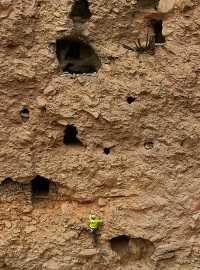
Climber Renan Ozturk watches a local Tibetan look at an illuminated manuscript found during an August 2008 expedition to remote Himalayan caves in the ancient kingdom of Mustang, today part of Nepal.

The folio is part of a treasure trove of 15th-century Tibetan art and manuscripts that could be linked to the real-world inspiration for Shangri-La, a fictional paradise described by British writer James Hilton in his popular 1930s novel Lost Horizon.

Until recently few have been able to explore the mysterious caves--carved high into sheer cliff faces--because Upper Mustang is a restricted area of Nepal that was long closed to outsiders. Today only a thousand foreigners a year are allowed into the region.

Click here to read full article
Read more >>
 
Asia Paranormal Google Page Rank
AsiaParanormal Blogger Template "Sleek 2" Designed by HypeSeek © 2012