A personal message from Oregon Chang

Have you had a close encounter story or witnessed something unusual that you would like to share?

Do you wish to collaborate with Asia Paranormal through link or content exchange?

Do you have any enquiries or feedback?

Email us at AsiaParanormal@gmail.com

We look forward to hearing from you!

Follow us on Subscribe Asia Paranormal in your favorite reader. Follow Asia Paranormal in Facebook. Follow Asia Paranormal in Twitter. Follow Asia Paranormal Youtube channel.

Vote for us! We are listed at the www.topparanormalsites.com website. Click here to vote for us.. Thank you :-)

Best regards, on behalf of team AsiaParanormal

Master Orthodox Occultist Oregon Chang, The 17th generation Disciple of Seven Stars Sword Master Hebei China

Showing posts with label Weird Animal Behaviours. Show all posts

Saturday, June 30, 2012

Scientists Confirm that Plants Talk and Listen To Each Other, Communication Crucial for Survival

When a South African botanist Lyall Watson claimed in 1973 that plants had emotions that could be recorded on a lie detector test, he was dismissed by many in the scientific community.

However, new research, published in the journal Trends in Plant Science, has revealed that plants not only respond to sound, but they also communicate to each other by making "clicking" sounds.

Using powerful loudspeakers, researchers at The University of Western Australia were able to hear clicking sounds coming from the roots of corn saplings.

Researchers at Bristol University also found that when they suspended the young roots in water and played a continuous noise at 220Hz, a similar frequency to the plant clicks, they found that the plants grew towards the source of the sound.

"Everyone knows that plants react to light, and scientists also know that plants use volatile chemicals to communicate with each other, for instance, when danger - such as a herbivore - approaches," Dr. Gagliano said in a university news release.

[Click here to read full article]
Read more >>

Thursday, June 21, 2012

Mysterious Poisonous Spiders Invade Indian Town

Swarms of never-before-seen spiders descended upon a cultural festival in the northeastern Indian town of Sadiya last month, biting several people and leaving two dead. The arachnid “invasion,” as the Times of India called it, caused a panic among festival-goers who reportedly jostled one another and tripped over benches in an effort to escape the venomous spiders.

Scientists from Dibrugarh University and Gauhati University have not been able to identify the spiders, which resemble tarantulas but may be a new species altogether. Ratul Rajkhowa, a professor of zoology at Cotton College in the city of Guwahati, told the Times that the spiders could be black wishbones, a species native to Southern Australia. If that’s the case, the spiders’ venom would not be deadly but could, in some individuals, cause severe allergic reactions that may result in death. The individuals who died after being bitten by the mysterious spiders were reportedly cremated before autopsies could be performed, and scientists have yet to test the toxicity of the spiders’ venom.

The sudden infestation nevertheless remains a concern for both scientists and Sadiya residents, as venomous spiders are not native to India’s Assam region, where the attacks occurred.

British naturalist Vejay K. Singh told the Times that, while swarms of spiders are rare, ”a certain anomaly in conditions may provoke an unusual surge in breeding populations…usually after flooding when the spiders search for dry and higher ground.” Post-flood spider swarms in Australia last March left farmlands blanketed in spiderwebs, while in Pakistan millions of spiders enveloped trees following last year’s devastating floods.

[Click here to read full article]
Read more >>

Saturday, June 16, 2012

Spacecraft Or Forage: What's Killing The Saiga Antelope?

Did a Soyuz spacecraft cause the deaths of hundreds of endangered saiga antelope in Kazakhstan this week?

Some ecologists think so, although scientists and the Kazakh authorities remain skeptical.

Officials say the carcasses of at least 543 saiga antelope have been found in northern Kazakhstan's Qostanai region since May 21, the latest reported mass death of the critically endangered animal.

And the fact that some 120 of the carcasses were discovered near the village of Sorsha -- the same location where a Soyuz capsule carrying a Russian-American crew from the International Space Station landed in April -- has sparked suggestions the animals may have been poisoned by chemicals left behind by the craft.

Likewise, in an interview with RFE/RL's Kazakh Service, ecologist Musagali Duambekov suggested that the mass deaths could be connected to the Baikonur space-launch site in central Kazakhstan.

"My personal opinion is that it is connected with human activity [and] that it is due to an anthropogenic factor," he said. "It could be from chemical elements left from space rockets that fly over this place, or from other chemical factors, such as the extensive use of fertilizers, which are very harmful."

[Click here to read full article]
Read more >>

Friday, June 8, 2012

Elephant and pig tapped to predict Euro 2012 games

WARSAW, Poland (AP) - Who's going to win the European Championship? Time to ask an elephant - or a pig.

Poland's answer to Paul the Octopus - the tentacled tipster who gained worldwide fame for his 2010 World Cup predictions - is Citta the elephant. Ukraine, however, will probably go for an enormous beer-loving pig - but there are big doubts about whether he can handle the media glare.
The parade of supposedly psychic animals comes as the two Eastern European nations gear up to co-host the continent's most prestigious soccer championship from June 8 to July 1.

The zoo in the southern Polish city of Krakow settled on a temperamental 33-year-old female pachyderm from India while Ukraine - where slices of hog fat are the national dish - is contemplating a happier destiny for a 2-year-old already named Psychic Pig.

The pig has a fondness for beer and fries and grunts in pleasure when he watches matches on television with his farmer owner, his publicist claimed Tuesday. But he still needs some PR training before he is presented to the public.

"We want to make sure he is calm - we don't want him to get scared," said Svitlana Bovkun, a spokeswoman for Kiev city administration.

[Click here to read full article]
Read more >>

Tuesday, May 22, 2012

Orang-utan who gnawed off own hand to escape trap recovers

An orphaned orang-utan who was forced to gnaw off its own hand to escape from a snare is now recovering after life-saving surgery.

Pelangsi lived off nothing but rainwater for 10 days before chewing off his own hand in a desperate bid to escape.

Thankfully the orphan was eventually rescued by the team at International Animal Rescue in Indonesia.

Pelangsi now could be released back into the wild in just a few months after a five-hour operation to amputate his damaged hand and arm.

Karmele Llano Sanchez, Veterinary Director at International Animal Rescue Indonesia, said Pelangsi was looking alert and eating.

"Pelangsi was clearly young and fit before getting trapped in the snare," he said.
"While it is a tragedy that he has lost his limb this is far better than him losing his life through septicaemia.

"There is no reason why he shouldn't return to the wild and fend for himself again.
"He's a wild orang-utan so finds it quite stressful to be in captivity, he tries to hide under the foliage in his cage whenever we approach him with darts and the blowpipe to sedate him."


Alan Knight, the charity's chief executive, said Pelangsi's story reflected the plight of many orang-utans in Borneo.

"He was driven from the forest when it was destroyed to make room for a palm oil plantation," he said.

"He was forced into an area where wildlife and humans are competing for space and food.

"Unfortunately we came too late to save his damaged hand but we certainly saved his life."

[Click here to read full article]
Read more >>

Thursday, May 10, 2012

Dolphins Dying in Record Numbers: Peru, China, India, and Gulf of Mexico

Scientists say they are investigating the mysterious deaths of 877 dolphins washed ashore in Peru this year. More than 80% of those dolphins were found in an advanced state of decomposition, making it difficult to study their deaths.

The porpoises and dolphin carcasses have washed up in a 220-kilometer (137-mile) area from Punta Aguja to Lambayeque, in the north of the country. Marine experts say the most likely cause is some sort of virus, but environmentalists claim sound waves from seismic oil exploration are to blame. The head of a local fisherman’s association said that he estimated more than 3,000 dolphins had died so far this year, based on what he saw in the water and on beaches.

The dolphin deaths in Peru are mark the third set of high-profile strandings in about two months. In February, 179 dolphins –108 of which were dead — washed ashore in Cape Cod, in eastern United States. Marine biologists are still trying to determine the cause of those deaths. In early March, amateur video taken from a beach in Rio de Janeiro, Brazil, showed more than 30 dolphins on shore. In that instance, all dolphins were safely returned to the sea.

In the fourth such incident in the past month, an eight-ft-long dead dolphin was washed ashore at Bandra Bandstand in Mumbai on the west coast of India. A humpback whale was found dead at Diveagar coast in Raigad last week. This came after two whales of the same species were found beached at Uran and off Priyadarshini Park, Napean Sea Road, on March 29 and March 31.

[Click here to read full article]
Read more >>

Thursday, April 5, 2012

Medieval medallion found in baby shark in Malaysia

Source: Phantom and Monsters Blog

A baby shark being prepared for lunch gave a Malaysian family a big surprise - an ancient artifact believed to be dated long before the Portuguese conquest of Malacca. Housewife Suseela Menon, from Klebang, made the priceless discovery while filleting the fish for lunch.

It is believed to be a medallion worn by the Portuguese soldiers, presumably as a divine protection, during their conquests in this part of the world in the 16th century. One side of the medallion is a profile of a woman's head with a crown and encircled by a halo and an inscription that is unclear. The other side is a crucifix with an engraved inscription that reads ANTONII.

Checks with a local historian revealed the head engraving could be that of Queen Elizabeth, the consort of King Denis I of Portugal during his reign from 1271 to 1336. Suseela said she immediately cleaned the medallion and preserved it in a box. “I bought two sharks from the wet market and was taken aback upon discovering the object inside the stomach of one of the fishes,” said the 47-year-old mother-of-two.

Suseela had wanted to prepare shark curry for her husband. “Finally, my husband decided not to eat the fish as the object seems to be a religious item,” she said. The medallion is 7.4cm long, 6cm wide and weighs 10g. “My husband feels it is a blessing for the family to have the medallion coming to our home from beneath the sea. We will always cherish it,” said Suseela.
Read more >>

Friday, March 23, 2012

Thousands of dead fish washed up in Pasir Ris

Light glinted off the bodies of thousands of fish in Sungei Api Api river yesterday morning.

The mesmerising sight surprised many residents who lived near the river in Pasir Ris.

The mass of swimming fish also caused the water surface to ripple.

"I thought it was raining at first," said Mr Mohammed Rahim Dasmin, 46, who passed the 1.2km river while cycling to work at 7.30am.

The storekeeper has lived in the area for more than 10 years, but it was the first time he had witnessed such a sight.

Housewife June Chua, 60, was on her way to the market when the crowd gathered at the river caught her attention.

Distracted, she walked over and was amazed to see the sight of thousands of fish.

"It was very beautiful," said Madam Chua.

However, a different sight - and smell - greeted her when she passed the site again in the evening to pick up her grandchildren from school.

Then, the stench of dead fish washed up along the river bank hit her even before she saw them.

Another resident, Madam Wati Mansor, whose home faces the river, compared the pungent smell to that of a fish market.

"I was cooking chicken for lunch and thought to myself, 'Why is the smell of fish so strong?'"

The 47-year-old housewife said the foul smell lingered in her second-storey flat throughout the afternoon.

Ms Haydee Allanigue was jogging around her estate in Pasir Ris and was about 100m from the river bank when she detected the odour of dead fish.

Like many others, the 33-year-old Pasir Ris resident was puzzled.

"I know it's fish, but why are there so many here?" she asked.

When The New Paper arrived at the scene at 5.30pm, workers were already clearing away the fish.

A 31-year-old foreman, who wanted to be known only as Mr Wanz, claimed that his team had been hard at work since about 8am.

"I have no idea when we're going to finish," he said.

Used in cooking

He believed that the dead fish is ikan tamban, a species commonly used in cooking.

In a joint statement, the Public Utilities Board (PUB) and National Environment Agency (NEA) said they were informed of dead fish at the mouth of Sungei Api Api this morning.

When they arrived at the site, dead fish were also found along the beach at Pasir Ris.

They were likely to have been washed in by the tide and some of them were deposited on the river bank of Sungei Api Api.

PUB assures the public that this incident has no impact on drinking water quality.

The water from the river is not used for drinking.

NEA is investigating the cause of the incident.

[Click here to read full article]
Read more >>

Monday, February 13, 2012

Scientists check out egg-laying rooster

Chinese scientists are investigating a bizarre case in which a cockerel apparently started laying eggs after all the hens were eaten.

The birds owner Huang Li, 47, kept the rooster together with seven hens on his small farm at Chumiao village, Mengcheng city, in central China's Anhui province.

He said that his family had been gradually eating the chickens over winter until only the rooster was left - and he was amazed when he went into the cage the next day to discover an egg.

He said: "I thought it was a joke and that one of my neighbours had put the egg in there for fun. But the next day there was another egg and so on the third day I waited - and was amazed when I saw that the rooster laid an egg."

[Click here to read full article]
Read more >>

Wednesday, January 11, 2012

Can Animals Sense The Spirit World

by Susan Thom

Are we human the only ones with blinders on, so we can’t see the aura of light surrounding spiritual beings? I had heard stories of animals seemingly knowing something else was in the room. My kids were about three, six, and eight when their paternal father became ill.

I was alone in the house with them, and the two older ones were in my son’s room playing, and my youngest was asleep in his room. I took the opportunity of being alone in my own room to call a friend. As we were talking, my kids came flying in, jumping on the bed, skin pale, breath panting, as they described a weird feeling in my son’s room, and our dog Sasha, barking incessantly at the wall between the two of my son’s rooms. She had scared them, and they had run down the hall and jumped into bed with me. I looked at the time, for some reason, and it was ten thirty. It was a Saturday night, and they were allowed to stay up until they got tired, usually around eleven thirty.

I tried to take them back to my son’s room, and show them there was nothing to be afraid of. They would not leave my room. I went myself, and searched for something to blame our dog’s behavior on. Sasha had continued barking at the wall, and I thought maybe there was a mouse or a squirrel stuck inside. Or maybe there was something on tv that was hurting her ears, or causing her in some way, to bark. No, the tv was off, and the kids had been playing monopoly. Everything was status quo except the dogs incessant barking, hair standing straight on end, and face pointed directly at the wall. My youngest had stayed sleeping through all the noise.

I decided there wasn’t much of an alternative, my two oldest would be sleeping in my king sized bed that night. They jumped in, got themselves comfortable, and we were about to watch a movie, when the phone rang. I remember it being eleven o’clock, and my mother in law was speaking to me. She explained that she and her sister had been with my father in law at the hospital all day, and decided to go to the cafeteria for some coffee. While they were gone, my father in law passed away.

Even though he had been quite sick, and my mother in law had been taking care of him for many years, she was obviously upset. They had been together for thirty five to forty years. She went on to say that around ten fifteen, they left his room, and when they returned, they were told he had passed at ten thirty!

Now it was turn for my hair to stand on end. If my father in law had passed, and wanted to say good-bye as he floated towards his eternity, he might have stopped by my older son’s room, into my younger one’s to say good bye to him as well. The dog had long since stopped barking. I got off the phone and told my kids what had happened. They had also heard about animals seeing spirits. They immediately put in together in their innocent brains. "Mommy, maybe that was grandpa coming to say good-bye." I was thinking the same thing. They jumped up out of my bed, and said they wanted to go finish their game. They were no longer afraid. They could deal with the barking being aimed at grandpa’s spirit. Our dog Sasha is twelve years old now, and never before, nor after, has she barked incessantly at a wall.

[Click here to read full article]
Read more >>

Monday, January 9, 2012

10 Wacky Animal Stories of 2011

by Jennifer Welsh

As the year draws to a close, here's a look back at some of the weirdest animal discoveries of 2011. From transvestite birds to zombie caterpillars and our own set of animal superheroes, it's been a wacky ride.

#1. A-Flock-Alypse?

This year started with a bang as scores of birds fell from the skies in January. The "aflockalypse" as it became called, harkened back for many to their first time watching Alfred Hitchcock's psychological thriller "The Birds," but experts agreed that the birds' and fish's mass deaths were just coincidental.

It started with the mysterious deaths of thousands of blackbirds in Arkansas and Louisiana around New Years' eve; this was followed by several reports of dead fish washing ashore and many more "massive" animal die-offs. In the end, the bang with which it all started was probably fireworks, which initially killed the blackbirds. Researchers agree the best explanation so far is the fireworks' noise and lights may have scared or disoriented the birds, causing them to fatally injure themselves flying into buildings, water towers and trees. The wide pickup of the original blackbird story probably set off the media attention later stories received, but these kind of die-offs are normal, researchers and ecologists say.

#2. Zombie Ants

The year was a big one for zombie insects. Reports of mind-controlled ants and caterpillars were enough to creep out even the least squeamish.

In May, in the journal BMC Ecology, researcher David Hughes from Pennsylvania State University reported that a parasitic fungus infects forest ants to fulfill its bidding. The fungus fills the ant's head with fungal cells and changes its muscles so the ant can grab a leaf in a death grip just when and where the fungus wants it — specifically, the zombie ants all bite down around noon, then all die together around sunset, like some weird fungus-addled ant cult. The fungus then bursts out of the ants' heads and spreads its spores to its next unwitting victim.

Another report in September found the genetic culprit that sends caterpillars to the treetops, where they liquefy and rain infectious death down on their peers. The virus that zombifies these gypsy moth caterpillars also makes sure they grow as large as possible so they spread infectious viruses far and wide, said study researcher Kelli Hoover, of Pennsylvania State University. They also send the caterpillars crawling up trees in the middle of the day, when they are most vulnerable to bird attacks.

#3. The mouse with two dads

In a wacky feat of genetic engineering and a stem-cell switcheroo, researchers created the first mouse baby from the genes of two male mice — a mouse that literally has two dads. The mousey Dr. Frankensteins, from the M.D. Anderson Cancer Center in Houston, turned cells from Dad No. 1 into X-only stem cells, which they injected into an egg to make a female mouse, which was then fertilized by sperm from Dad No. 2.

The study, published in the journal Biology of Reproduction, is the first step to making human children from two men, though that is a long way away. This mean feat of genetic engineering was also dubbed by LiveScience reporter Stephanie Pappas as "scientific progress at its cutest" when she met the mice in person.

#4. Animals with superhero senses

Scientists aren't the only ones turning miraculous tricks this year. Mother Nature has a few up her sleeve as well. Animal super senses turned up in dolphins and vampire bats in 2011, and even one possible sixth sense in humans made an appearance.

Researchers at Rostock University in Germany discovered that the common Guiana dolphin has a special sixth sense: It can sense electric fields with a special organ on its snout. While the ability is common in fish, the dolphins are the first placental mammal (as opposed to a marsupial mammal) found to sense electricity, which they probably use to find fish in the shallow, murky waters they call home.

In other odd animal senses, researchers discovered in August that the vampire bat can "see" heat from veins and arteries using a special organ on its nose that is incredibly sensitive to heat. The bat uses this organ to find blood meals and to bite the right part of the skin: A mouthful of hair is unappetizing to these little bloodthirsty critters.

A possible extra human sense also made an appearance this year. A human protein, when expressed in fruit flies, has the ability to detect magnetic fields. The researchers caution that the protein might not work that way in humans, though. Sorry, Magneto wannabees.

#5. Strange sperm

It may not be super, but strange sperm abounds in the animal kingdom.

Studies in naked mole rat sperm show that these weird little creatures also have weird little sperm. In any other animals their sperm samples wouldn't pass quality control, but these eusocial underground rodents make do just fine with their mutant sperm, a study published in the December issue of the journal BMC Evolutionary Biology shows.

Ducks also have special sperm properties, another 2011 study shows. Their sperm contains antibiotics that might protect them and their mates from sexually transmitted infections. The brighter their bill is, the better their sperm is at killing off bacterial invaders, suggests the study published in April in the journal Biology Letters.

#6. More strange sex

Sperm wasn't the only weird animal-sex finding of 2011. Multiple studies found everything from hermaphroditic bulldogs to sexually confused fish and birds.

The bulldog Bijou is genetically female, but has some physical properties of a male dog, including a prostate gland and testicles. Researchers are stumped as to why this pup, and another bulldog, Tana, had these male characteristics without male genes.

Other animal he-shes are also stumping researchers this year: A cardinal with half-male, half-female coloring seems to be a genetic anomaly, with half-female and half-male cells. Several sex-changing birds also made the news in 2011, including a female chicken that transformed into a rooster in the United Kingdom over a few weeks time. Researchers think that a tumor or cyst may have caused the switch.

Some birds of prey don female plumage, but don't actually change gender. These transvestite marsh harriers use such sexual mimicry to fool other males into leaving them alone, researchers reported this year.

#7. Cyclops shark

Strange sex-changing animals weren't the only weirdoes nature threw at us this year. A Photoshop-quality image of a fetal shark with one eye stunned researchers and cybergawkers alike when it made the news in October. The one-eyed fetus was cut from the belly of a shark in the Gulf of California, but would not likely have survived outside of the womb.

"This is extremely rare," shark expert Felipe Galvan Magana of Mexico's Centro Interdisciplinario de Ciencias del Mar told the Pisces Fleet Sportfishing blog in July. "As far as I know, less than 50 examples of an abnormality like this have been recorded." [Photos of Cyclops Shark]

Other, less scientifically based reports of Yeti nest sightings and hair samples from Russia splashed the news this year. And scientists reported finding the lair of a 'Kraken' sea monster, though the interpretation of the finding has not been substantiated.

#8. Fishy sexual harassment

Several advancements in the field of fishy sexual harassment made the news this year, indicating that Trinidadian guppies seem to have more gossipy drama and sexual tension than an episode of "Sex in the City."

A study published in October showed that when a harassing male chases down female guppies, they are more likely to get in fights with other females. The sexually charged males stress these females out so much they end up turning on each other, the researchers said.

Another study showed that these same guppies, when harassed, pair up with prettier females, whose presence draws attention away from themselves.

#9. Animals with protective poisons

Scientists have long understood that plants use poison to defend themselves, but traditionally animals are thought to defend themselves with weapons like sharp teeth and claws. In 2011, a number of animals were discovered to wield poisons of their own.

By utilizing the same plants that African tribesmen use to poison their arrows, the furry fury known as the African crested rat can incapacitate and even kill predators many times its size, research published in August found. The rat chews poisonous bark and spits the poison onto its furt coat, which has specialized hairs with pores to absorb the animal's poisonous spit, which protects them against predators like dogs.

Another odd animal poison discovered in 2011 is the cyanide-sweating millipede discovered in September. When disturbed, the bugs emit a toxic cyanide goo and foul-tasting chemicals that deter predators looking for a snack. Luckily for its predators this odd insect also has a nighttime glow to warn predators of its poisonous secretions

#10. The loudest genitals

One loud little insect makes a big call, from an unorthodox organ. Research published in July indicates that by using its genitals, the water boatman makes the loudest song for its size: At less than one-tenth of an inch (2.3 millimeters) long, it calls out to mates at over 99 decibels, as loud as an orchestra. The odd insect's song from the depths of a river can even be heard along its banks, the researchers said, and is likely created when the animal rubs its genitals against ridges on its body, though the scientists aren't sure how the sound gets so loud.

[Click here to read full article]
Read more >>

Sunday, January 1, 2012

Magpies 'mourn' Kim Jong-il in North Korea

A surreal phenomenon takes place in North Korea as dozens of magpies perch on trees to mourn deceased leader Kim Jong-il, state television KRT says.

Read more >>

Thursday, December 22, 2011

The killer badgers of Basra

Honey Badgers

BASRA, Iraq — Nazariya al-Muwamara, they call it in Arabic: the conspiracy theory. As they go, this one is a gem.

Take a Western army wearing out its welcome in the ancient land of Mesopotamia. Add a large, sharp-toothed creature halfway between a bear and the Hound of the Baskervilles. Simmer in the 120-degree Fahrenheit (49-Celsius) temperatures of summer and sprinkle with provincial Iraqi newspapers eager to fill newsprint gaps left by vacationing government officials.

The result? Many residents of the southern city of Basra have convinced themselves that the British Army has loosed savage cattle-eating badgers onto its unsuspecting populace as a final gesture of ill intent before it departs the city later this summer.

Throw in, for good measure, the fervent belief that British soldiers have planted snake eggs in waterways and unleashed bomb-sniffing dogs purposefully infected with rabies.

All three stories have been manufactured by Iraq's tireless rumor mill, the only machine here seemingly capable of functioning day and night without need of electricity or generators.

Iran has gotten in on the act as well, claiming that Western forces have been fitting Iraqi squirrels with miniaturized surveillance devices and sending them scurrying across the border to spy.

"In recent weeks, intelligence operatives have arrested 14 squirrels within Iran's borders," IRNA, the Iranian state-sponsored news agency, reported. "The squirrels were carrying spy gear of foreign agencies, and were stopped before they could act, thanks to the alertness of our intelligence services."

As for the badgers, the distinction between reality and fiction has been somewhat blurred by the fact that some of the animals do actually live around Basra. That much is verifiable. But many of the deeds and intent ascribed to the creatures are not.

One Basra farmer claimed the beasts attacked his cattle. Panic spread, with other reports of one killing humans.

The alarm was heightened by the rapid circulation of a cellphone video showing one fearsomely clawed animal captured and surrounded by nervous villagers, who invoked the name of Shia Islam's first and most-revered imam: "What's that? Help us, Ali!"

The British were soon blamed, perhaps aided by the unfortunate coincidence that one of the British Army units serving in the city center is named Badger Squadron.

The reality, Iraqi officials point out, is that the badger, named Kirta or Gariri in Arabic, has been a native of the marshland area around Basra for decades. Less commonly seen after Saddam Hussein drained the marshes, it has reappeared as the wetlands returned.

"Old people know of the Girta, but the younger generations are not as aware of these animals," said Mushtaq Abdul-Aziz of Basra's Health Department.

Major Mike Shearer, a British military spokesman in Basra, rebutted all animal-related allegations with an admirably straight face: "Of course we categorically deny that we have released badgers into Basra. "It flies in the face of what we are primarily here to do, which is to set conditions that will enable the Iraqi security forces to have self-determination in their own security matters, which of course sets the conditions for good governance."

A spokeswoman for the British Foreign and Commonwealth Office was somewhat more succinct in denying the rumor. "Don't be silly," she said, after sighing.

At the British headquarters, commanders have weightier matters to consider. On senior officers' desks sit copies of Carl von Clausewitz's 1832 treatise "On War" and David Galula's colonial-era French manual "Counterinsurgency Warfare." Neither is definitive on the deployment of baby-eating monsters or surveillance squirrels.

Asked whether coalition forces were ever likely to have been as welcome in Iraq as pre-war optimists hoped, one senior British officer shook his head wearily. "It would have been difficult, given the conspiracy mindset," he said. "Just look at the badgers."
Read more >>

Sunday, November 13, 2011

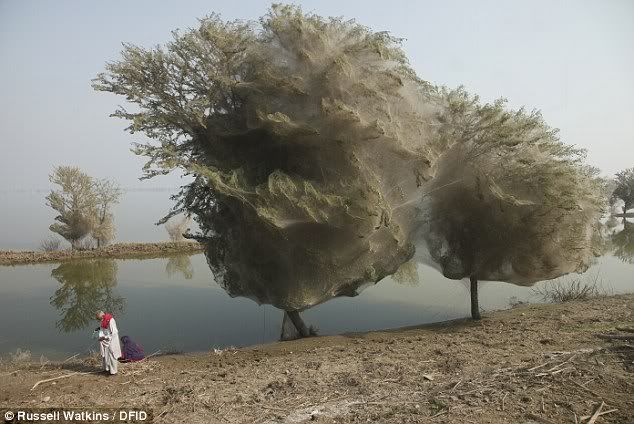
The ghost trees of Pakistan: Spider webs cocoon branches in creepy after-effect of floods

Millions of spiders have crawled into trees in Pakistan to escape flood waters, shrouding them with their silky webs.

The eye-catching phenomenon is an unexpected side-effect of last year's flooding which claimed the lives of almost 2,000 people.

However, since the monsoon weather devastated the nation last July, much of the water has still not yet receded.

The tiny arachnids have sought refuge amongst the trees weaving beautifully intricate webs between the leaves.


Copyright to Daily Mail

The branches are now so cocooned in spiders webs it gives the appearance of them being shrouded in a large net.

People in this part of Sindh, in south eastern Pakistan, near Karachi, have never seen this phenomenon before, but locals are reporting that there are now fewer mosquitos than they would expect, given the amount of stagnant, standing water that is around.

It is thought that the mosquitos are getting caught in the spiders web and reducing the risk of malaria, benefiting local people.

The 2010 Pakistan floods began in last July following heavy monsoon rains in the Khyber Pakhtunkhwa, Sindh, Punjab and Balochistan regions of Pakistan.

About one-fifth of Pakistan's total land area was underwater, affecting about 20 million people whose homes, livelihoods and infrastructure was destroyed.

[Click here to read full article]
Read more >>

Monday, November 7, 2011

Jatinga Bird Mystery

Jatinga, famous for the phenomenon of birds “committing suicide”, is located on a spur of the Haflong ridge, the head quarter of the district. It itself is an offshoot of the main ridge of the Borail range. It is centrally located at the junction of the roads leading to Haflong, Lumding and Silchar.

Here the mist & fog lie like a veil around the beautiful face of the damsel from September to November. During these late monsoon months, mysterious behaviour of birds takes place. However, some other conditions are also necessary for the phenomenon to occur. The air must be foggy, cloudy or misty. If there is slight rain, it would be even better. The wind must be from south to north. It should be moonless dark nights. And the best time is between 7 p.m. and 10 p.m.

Curiously, most of the doomed birds do not attempt to fly away after they land near the lights. They look dazed and disheveled, perhaps due to the trauma of the whole shocking experience. Such birds fall easy prey to the villagers. Some of the birds hovering around the light sources are brought down by a vigorous swing of the bamboo poles. Catapults are also used to bring down the birds in flight as well as those perching on the trees and bushes near the light sources.

However, contrary to the popular belief, birds do not commit suicide. Under circumstances not yet fully explained, these birds get caught in the fog and wind, get disoriented and seek solace of the light sources put out by the villagers. They hit against trees or other objects and get injured in their flight towards the light source. The villagers hit the hovering birds with bamboo poles or catapults to bring them down

Various studies have been conducted to unravel the causes behind this phenomenon. The record maintained show that 44 species have been attracted to the light sources. It has been established that the birds are not attracted to the entire Jatinga Ridge but only to a well-defined strip, 1.5 km long and 200 metres wide. Invariably the birds come in only from the north and attempts at placing the lights on the southern side of the ridge to attract the birds have failed.

Another interesting fact has been brought out is that no long distance migratory bird gets attracted to the light traps. The victims are resident birds of the adjacent valleys and hill slopes.

The unusual behaviour of the birds seems to occur due to the peculiar weather conditions at Jatinga. There also appears to be a correlation between the breeding period of the birds and the Jatinga phenomenon. Studies also reveal that the flight of water birds to Jatinga may be attributed to heavy rains and floods and submergence of their natural habitat in the surrounding areas.

t has been observed that there was a high congregation of birds at Jatinga during 1988 which happened to be a year of high floods. Renowned ornithologists Dr. Salim Ali, Dr. S.Sengupta, A. Rauf etc have carried out researches on this subject. However, no single hypothesis comprehensively explains the Jatinga mystery till date. The problem deserves deeper scientific study from various angles.

[Click here to read full article]
Read more >>

Saturday, November 5, 2011

The Sankebetsu Brown Bear Incident

Sankebetsu Rokusen-sawa, November 1915

A large Ussuri Brown Bear is spotted outside of the rural pioneer village of Sankebetsu Rokusen-sawa. The bear is shot at, a hunting party tries to track it down, and a fierce snowstorm forces them to give up their hunt. This would prove to be a most disastrous mistake.

December 9th

At 10:30 am, the bear rampages into the farmhouse of the Ota family. The farmer's wife, Abe Mayu and a baby in her care were the only ones home. The baby was bitten in the head and killed. Mayu tried throwing fire wood at the bear and ran, but the bear overtook her and dragged her into the woods before killing her.

December 10th

The following day, a 30 man search party is formed to find the bear and the body of Mayu. While scouring the woods surrounding the village, the men encounter the bear. Five men shoot at it, one man actually wounds it, and the bear retreats. Nearby, the search party finds dried blood in the snow at the base of a tree. Buried in the snow are the head and parts of the legs of Mayu. The bear has become a maneater.

Later that evening at approximately 8:00pm, the bear returns to the Ota homestead. This causes a mass panic through the guardsmen and all armed men in the village hurry to try and attack the bear. The bear disappears into the forest.

Within the hour, the bear comes back to the village, only this time to the Miyoke homestead. There is only one man present at the home; the remaining people consist of mothers and children. The bear crashes in through a kitchen window as Yayo Yasutaro is preparing a meal whilst carrying her son Umekichi on her back. In the following chaos, the dinner pot is knocked into the fire, putting it out. The only other source of light (an oil lamp) is also knocked out, enveloping the home in darkness. Yayo tries to run but is tripped by her second son Yujiro trips her. The bear bites both Yayo and Umekichi.

Odo was the only present bodyguard and when he ran for the door, the bear left the mother and child to pursue him. He tried hiding behind furniture, but the bear eventually caught him. The bear then mauled three of the young sons from families of the village. After killing the four males, the bear killed and partially devoured the pregnant Take Ishigori.

Following the bloody aftermath, the bear had tallied six kills at this point. The villagers were so terrified some began leaving the village and only veterans of the Russo-Japan war remained as guardsmen.

Enter Yamamoto Heikechi

Following the attack on his home and family, Miyoke Yasutaro left to track down a man by the name of Yamamoto Heikechi, a famous bear hunter. After telling Heikechi what was happening, Miyoke came to find that Heikechi had pawned his gun for alcohol and was more interested in drinking than bear hunting at the moment. After much persuasion, Heikechi came to help the village.

December 12th

The bear had not been seen since the maulings on December 9th. A task force of 6 men, led by Heikechi, decides to lure the bear to the Miyoke home using the corpse of a victim. They set up the corpse and wait for the bear to appear. The bear comes to the edge of the forest but for some reason retreats back, ultimately ignoring the trap. The following morning, the guards find the Ota house ransacked. The bear had eaten all of the winter food store in the home.

December 13th

Yamamoto nicknames the bear "Kesagake" and police chief Suga decides that more preemptive measures are needed to protect the village. An ice bridge is constructed and snipers are placed all around. That night, some of the snipers spot a 'large shadow' moving along the edge of the woods. After calling out to it and receiving no reply, Suga orders the snipers to open fire.

December 14th

After investigating the edge of the river the shadow was seen on, a bear track and some blood are found. Yamamoto and Ikeda Kamejiro, a guide, immediately set off after the bear. They successfully find the bear and Yamamoto gets within 20 meters of Kesagake before firing two shots: one to the head and one to the heart.

After falling Kesagake, the village finds that the bear is 8.9 feet tall and weighs 836 lb. They find human flesh in the bear's stomach.

[Click here to read full article]
Read more >>

Saturday, September 24, 2011

Smoking orangutan goes cold turkey in Malaysia


Picture is (C) copyright to AFP

KUALA LUMPUR - An orangutan that amused visitors to her Malaysian zoo by smoking cigarette butts thrown into her cage is being forced to go cold turkey, a keeper said Monday.

Authorities seized the orangutan, named Shirley, along with a tiger and other animals from a state-run zoo in the southern state of Johor last week after they were found to have been kept in poor conditions.

Shirley, believed to be more than 20 years old, has been transferred to Malacca Zoo where she will be forced to kick the habit, said the institution’s director Ahmad Azhar Mohammed.

“When we brought Shirley here, she is just like a normal orangutan... But orangutans are very smart animals. They will follow what people do,” he told AFP.

He said “irresponsible visitors” would throw lit cigarette butts into Shirley’s cage at the Johor Zoo, which she would pick up and smoke.

Ahmad Azhar said Shirley was expected to stay at the Malacca Zoo for about a month before being transferred to a rehabilitation centre in Sarawak state on Borneo island, where orangutans still live in the wild.

Malaysia has pledged to better protect animals from abuse and illegal trade, which critics say still flourishes in the Southeast Asian country.

Earlier this month, police rescued about 300 cats from a pet-boarding business after its operators left them without adequate food and water and in filthy cages for days.

[Click here to read full article]
Read more >>

Saturday, September 10, 2011

Strange Sensations: Can Animals Sense Earth Changes?

Aug 25th in Natural World by Micah Hanks

It started with a curious noise outside… I actually thought there may have been an explosion. I stepped outside, with Eik, a trusty Rottweiler I’ve been watching for the past few days courtesy of some friends who are out of town, following directly behind me. Scanning the sky, as well as the rest of the neighborhood for anything strange, we couldn’t seem to find the source of this strange “explosion.” But this would hardly be the end to our strange day… in fact, it was only the beginning!

I went back to work, answering emails and trying to crank out a few more articles (like this one) before a mid-day radio interview promoting the newest book in the Exposed, Uncovered and Declassified series that I’ve contributed to, titled Ghosts and Hauntings: Am I being Haunted? There had been phone calls coming in all day too, in addition to everything else going on, and at the moment in question my father had called to check in about a rendezvous time for an engagement we were attending together later that day. That’s when the sudden, blood-curdling howling began…

“Hold on dad, these dogs are going nuts!” I remember saying, as I rushed back to the bedroom where Eik and his sister, Sammie, were laying on the bed. They weren’t attempting to move otherwise, save for the lonesome howling they were both engaged in. I listened carefully to try and see if there was anything in the distance–perhaps a siren–that the dogs might be able to hear, but there was only silence. What had gotten these guys so stirred up all of a sudden?

[Click here to read full article]
Read more >>

Thursday, August 25, 2011

Monkeys break into top Indian hospital via automatic doors

By Kate Goodacre, News Subeditor

Monkeys have invaded a leading Indian hospital after working out how to use its automatic doors.

Staff at the All India Institute of Medical Sciences (AIIMS) told The Times of India that the rhesus macaque monkeys have been sneaking into wards and recovery rooms, having learned that the hospital's new automatic doors operate using motion sensors.

A doctor at the New Delhi hospital said: "I was at the patient recovery room when a nurse cried out that a monkey had sneaked in. The monkey had somehow entered the main corridor and was hiding in the false roof.

"As soon as the security guard moved away, it jumped inside."

[Click here to read full article]
Read more >>

Wednesday, August 17, 2011

Thousands Of Birds Flocking Hypnotically

Thousands of starlings flying together form an ever-changing cloud against the backdrop of a New Zealand sunset. These massive flocks appear all around the world. Birds generally move in a V-shaped formation because it helps them conserve energy. Since each bird flies in front of the other there is less wind resistance. But, it wouldn't be fair for one bird in the front to get the brunt of the trip so birds periodically switch around creating a hypnotic wave-like motion.


Read more >>
 
Asia Paranormal Google Page Rank
AsiaParanormal Blogger Template "Sleek 2" Designed by HypeSeek © 2012