A personal message from Oregon Chang

Have you had a close encounter story or witnessed something unusual that you would like to share?

Do you wish to collaborate with Asia Paranormal through link or content exchange?

Do you have any enquiries or feedback?

Email us at AsiaParanormal@gmail.com

We look forward to hearing from you!

Follow us on Subscribe Asia Paranormal in your favorite reader. Follow Asia Paranormal in Facebook. Follow Asia Paranormal in Twitter. Follow Asia Paranormal Youtube channel.

Vote for us! We are listed at the www.topparanormalsites.com website. Click here to vote for us.. Thank you :-)

Best regards, on behalf of team AsiaParanormal

Master Orthodox Occultist Oregon Chang, The 17th generation Disciple of Seven Stars Sword Master Hebei China

Sunday, November 13, 2011

The ghost trees of Pakistan: Spider webs cocoon branches in creepy after-effect of floods

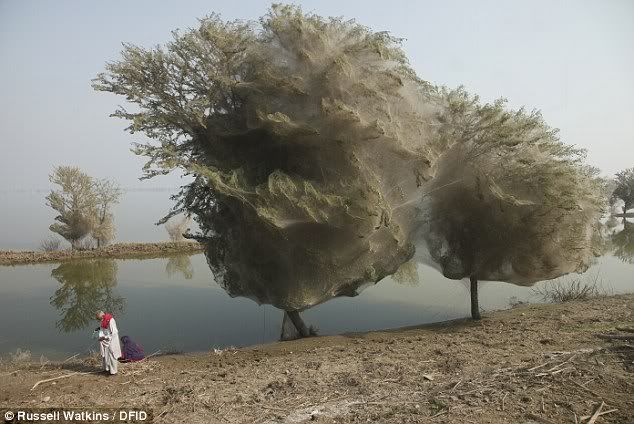
Millions of spiders have crawled into trees in Pakistan to escape flood waters, shrouding them with their silky webs.

The eye-catching phenomenon is an unexpected side-effect of last year's flooding which claimed the lives of almost 2,000 people.

However, since the monsoon weather devastated the nation last July, much of the water has still not yet receded.

The tiny arachnids have sought refuge amongst the trees weaving beautifully intricate webs between the leaves.


Copyright to Daily Mail

The branches are now so cocooned in spiders webs it gives the appearance of them being shrouded in a large net.

People in this part of Sindh, in south eastern Pakistan, near Karachi, have never seen this phenomenon before, but locals are reporting that there are now fewer mosquitos than they would expect, given the amount of stagnant, standing water that is around.

It is thought that the mosquitos are getting caught in the spiders web and reducing the risk of malaria, benefiting local people.

The 2010 Pakistan floods began in last July following heavy monsoon rains in the Khyber Pakhtunkhwa, Sindh, Punjab and Balochistan regions of Pakistan.

About one-fifth of Pakistan's total land area was underwater, affecting about 20 million people whose homes, livelihoods and infrastructure was destroyed.

[Click here to read full article]
Read more >>

300 Japanese soldiers died at Raffles Hotel?

Photobucket

Did 300 Japanese soldiers die at Raffles Hotel in 1945? Is it possible that a collective suicide of 300 people went down unnoticed?

To refresh your memory: during the Japanese occupation of Singapore (15 February 1942 – 22 August 1945), Raffles was renamed Syonan Ryokan, incorporating ‘syonan’ ("Light of the South"), the Japanese name for occupied Singapore, and ‘ryokan’, the name for a traditional Japanese inn. Until the end of the war, Singapore, and with it of course Raffles Hotel, remained occupied by the Japanese. After the surrender of the Japanese forces in 1945, many officers and soldiers committed suicide.

Photobucket

So where did these websites get the 300-strong grenade suicide idea from? Well, it seems to be a clear case of muddling the facts from an earlier report, in the Sunday Times (that’s the New Straits Times, Singapore). According to the paper, recently released top-secret documents from World War II show that on 22 August 1945 a mass suicide did take place at the hotel. The Times story said: ‘That night, more than 300 Japanese officers and men held a farewell sake party at one of the lounges in the Raffles Hotel. Then, leaning on their short swords, 'they hastily returned to their ancestors'. A whole Japanese platoon later pulled the pins off hand grenades and blew themselves to pieces.’

Then, the report was abridged to form a different version in several publications, including the entry on Wikipedia:

Raffles Hotel - Wikipedia, the free encyclopedia: More than 300 Japanese troops committed suicide in the hotel using grenades...

So there are two separate versions, one seemingly exaggerated significantly. But let’s see if we can shed some light on the reports. I’ve spoken to Roberto Pregarz, the former manager of Raffles Hotel, who remembers staff from World War II. He said:‘I doubt that 300 of them committed suicide at Raffles. I had never heard this story. Some of my staff like our cashier Tan Geok Swee worked at Raffles during the Japanese occupation and never mentioned this. And he told us lots of stories.’

Meanwhile, Ilsa Sharp, the first biographer of Raffles Hotel, who interviewed former Raffles employees and managers for her detailed account, equally confirms:‘It’s seems to be an extreme exaggeration of old stories, like the legend that the guests at Raffles danced on until very late in the Japanese bombardment of Singapore etc (true – but not as late as this story suggests) and that a couple of Japanese soldiers may have committed suicide in the hotel at the end of the war. Certainly not with grenades and certainly not 300!’

It seems to be a case of exaggerating reality. But let’s clear it up.

By opening this blog, I am calling on soldiers from Japan, who were in Singapore during that time, and the Japanese war archives for an official statement. Please support our duty to settle this matter, once and for all.

[Click here to read full article]
Read more >>

Saturday, November 12, 2011

MTV hires psychic to accept award for Kurt Cobain


Picture is copyright to MTV

MTV must have really wanted to talk to Kurt Cobain — why else would the TV network have hired a psychic to contact the Nirvana frontman?

Did somebody say publicity stunt? No way — that doesn’t sound like MTV, home to critically acclaimed shows like “16 and Pregnant” and “Jersey Shore.”

MTV brought in psychic Fahrusha to channel Cobain so he could accept an O Award for best vintage viral video for the Nirvana song “Smells Like Teen Spirit.”

Did anyone tell MTV that there are two perfectly good — and, more importantly, alive — members of Nirvana still wandering around? Krist Novoselic is busy tweeting things, and Dave Grohl is singing in Foo Fighters.

Nevermind, MTV. (Nirvana pun not intended.) You go right ahead and channel Cobain.

[Click here to read full article]
Read more >>

Traditional Malay Mythological Creatures and Legendary Ghosts (Part 2 of 2 )

by Oregon Chang

Dear Readers, please do note that in Malay culture and traditions, much of the be it demonic monsters or ghosts are about same. A monster is a ghost and a ghost is also a monster. They do not make too much of a difference to them.

The locations of these monstrous creatures and ghost are pretty much shared in the Malay archipelago or neighbouring nations. Some of it can in the nation's own version or if not exactly or about the same.

This are the list of countries where these creatures have appeared either in folklore or witness sightings:
1) Malaysia
2) Indonesia
3) Singapore
4) Thailand
5) Philippines
6) Brunei
7) Papua New Guinea
8) Cambodia
9) Vietnam
10) Myanmar (Burma)
11) India

List of Malay Mythological Creatures (11 to  25 )

Photobucket

11) Hantu Bajang

Photobucket


Hantu Bajang is a spirit who takes the form of a fox or polecat and who eats fetuses and drinks the milk of lactating women.

12) Hantu Kopek

Photobucket

A variant is Hantu Kopek (Nipple ghost), who appears as an old woman with pendulous breasts. The striations of pregnancy are said to be the scars left by the attack of the bajang. Sharp metal objects such as scissors placed near the baby will help to protect it from the bajang

13) Polong

Photobucket

Polong is a spirit ghost that can be used by a black magic practitioner to harm someone. It is said to have been created from the blood of a murdered person and this blood is put into a bottle for one to two weeks before the spirit is invoked with incantations and magic spells. The owner must feed the polong daily with blood from his finger.

14) Pelesit

Photobucket

Pelesit is another ghost made by magic, in this case from the tongue of a stillborn child. It enters a house in the form of a cricket or house fly, and spreads misery and unhappiness in advance of the arrival of a polong. It also drinks blood from open cuts or wounds. Both the pelsit and the polong can be forced to reveal the name of their owner through magical questioning.

15) Hantu Raya

Photobucket

A Hantu Raya (great ghost) is the most dangerous of Malay ghosts. It has great strength and can change into any shape, may help its owner become rich and may cause harm or death to the owner's enemies. However, the ghost may also impersonate the owner, making love to his wife. The ghost is said to have a limited range, being unable to go far from its home.

16) Ceplos

Photobucket

Ceplos is a type of childish youthful male ghost which main objective is to protect its owner, especially warding off other black magic practitioner or ghost owner.

17) Hantu Air or Laut

Photobucket

Hantu Air (water phantom) also called Hantu laut (sea phantom) is a water spirit or ghost that lives in rivers, pools or the sea. It may be the ghost of someone who has died through drowning, or may be an independent spirit. Sometimes it appears as a floating log. The ghost or spirit may be dangerous, and may drown or eat people.

18) Hantu Bungkus or Pocong

Photobucket

Hantu Bungkus or Pocong is a ghost wrapped in a shroud that feeds on the blood of babies. It always runs after the victims by the means of jumping as it's hands and legs are tied up or wrapped up.
In some cases, it has been said that it will seek and plead you to untie her/him and in exchange it will grant you only one wish. But again do you really expect them to keep to their words in every case?

19) Hantu Galah (pole ghost)

Photobucket

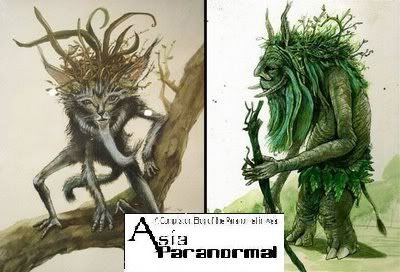
Hantu Galah (pole ghost) is a very tall and thin ghost found among the trees and bamboos. To make it disappear, a person simply picks up a stick or twig and breaks it.It is normally female

20) Hantu Pari-Pari - fairy ghosts

Photobucket

Hantu Pari-Pari - fairy ghosts. It is normally female.

21) Harimau akuan

Photobucket

Harimau akuan: a were-tiger, or a human in the form of a tiger.It is normally male

22) Jembalang Tanah

Photobucket

Jembalang Tanah are earth demons of virgin forest. Derive from the urine or umbilical cord is buried in the forests.

23) Jenglot

Photobucket

Jenglot is a doll-sized creature that is said to be found in the jungles of Malaysia and Indonesia, described as a vampire in habit. Dead jenglots are sometimes sold or exhibited, but appear to be man-made.Most of them is female

24) Orang Bunian

Photobucket

Orang Bunian (whistling people) are invisible forest spirits who may lead travelers astray, but may sometimes assist them. There are stories of human men marrying female Orang Bunion, but as a result also becoming invisible.It is normally female.

25) Orang Minyak

Photobucket

Orang Minyak (Oily Man) is a rapist who believes in mystical properties of forced sex. A supernatural Serial Rapist ghost which is hard to see and hard to catch as he is covered in black grease and uses night as camouflage.
Read more >>

Friday, November 11, 2011

Hollywood psychic claims to have made contact with Amy Winehouse

By Marissa Charles

Amy Winehouse has spoken from beyond the grave, according to a celebrity psychic – who claims to work with some of Tinseltown’s biggest names.

New Yorker Kimberly Padula’s claims come as a coroner determined that the tragic star drank herself to death.

Padula, who says that she is on the payroll of some of Hollywood’s most influential people, claims that she contacted Winehouse in September, two months after the Rehab singer died at the age of 27.

Talking about “going into” Winehouse’s body, she says: “I got her suffocating. I got her not breathing. There was [alcohol], for sure. I don’t get foul play, though.”

Padula also shockingly claims the London-born star blames herself for her demise, saying that she had a “death wish” and that, although she didn’t kill herself, she had considered suicide at times.

“She’s saying it’s her own fault [that she died],” the 37-year-old says. “She’s not blaming anybody. She’s saying she wasn’t strong enough…

“Her poor little heart couldn’t take it anymore. Her body was so f***** up, weak, deficient, not healthy at all. Anaemic. Not eating. Super-weak. Emaciated.

“It wasn’t fun how she died. It happened quickly, though. It wasn’t a long thing… She just stopped breathing.”

Padula says that she could see Winehouse’s face, as she allegedly communicated with the dead star and that – despite her short life – she is at peace and she suspects that her grandmother “helped her over”.

“Relieved is what I’m hearing,” she says when asked if Winehouse is happy. “She’s happy that her family’s taken care of now.”

[Click here to read full article]
Read more >>

Traditional Malay Mythological Creatures and Legendary Ghosts (part 1 of 2)

by Oregon Chang

Dear Readers, please do note that in Malay culture and traditions, much of the be it demonic monsters or ghosts are about same. A monster is a ghost and a ghost is also a monster. They do not make too much of a difference to them.

The locations of these monstrous creatures and ghost are pretty much shared in the Malay archipelago or neighbouring nations. Some of it can in the nation's own version or if not exactly or about the same.

This are the list of countries where these creatures have appeared either in folklore or witness sightings:
1) Malaysia
2) Indonesia
3) Singapore
4) Thailand
5) Philippines
6) Brunei
7) Papua New Guinea
8) Cambodia
9) Vietnam
10)Myanmar (Burma)
11) India

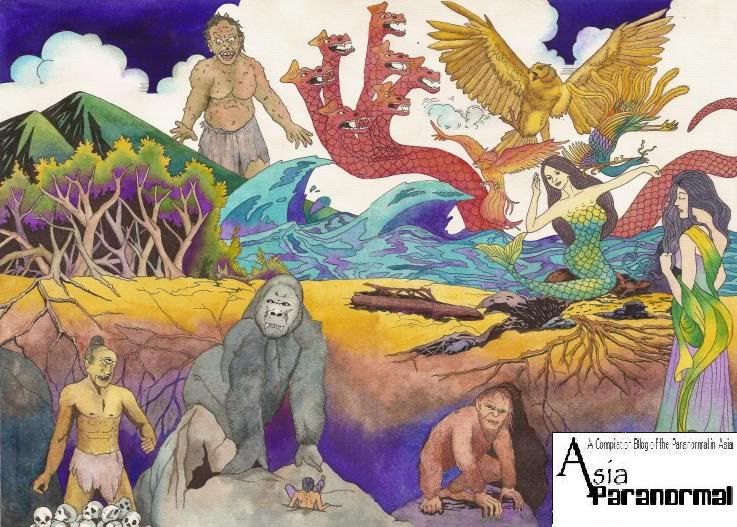
List of Malay Mythological Creatures (1 to 10)
Photobucket

1) Sang Kelembai

Photobucket

The Sang Kelembai or Gedembai are supernatural beings inhabiting in the forests of Malaysia . Kelembai has powerful magical curse that can turn anyone to stone. Kelembai(s) confines to noise as it is in the forest.
Sang Kelembai is as an ugly woman with thick eyebrows, a flat nose, big elephant ears, fanged teeth, and about three times the size of a normal person. Feda on the soft top leaves of bamboo plants and occasionally fruit and meat.

It has the power of transforming any human or animal into stone and non other forms. For a Kelembai to turn someone to turn into stone, the Kelembai has to begin with by talking to that person or animal, and this can made her even more deadly.

2) Malaysian Dragon
Photobucket


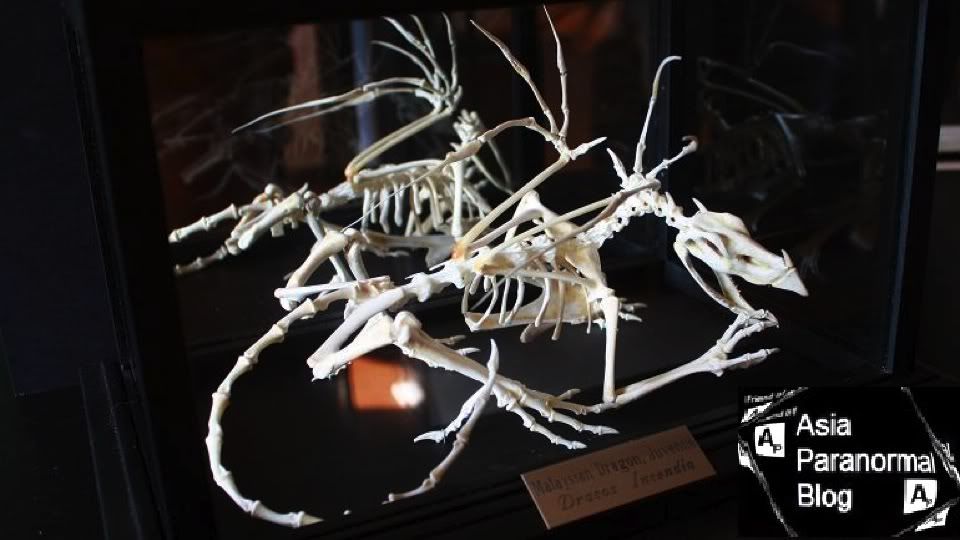
The Malaysian Dragon or Naga (Draco naga) – are species found in the East Indies – modern day Malaysia, Indonesia, and Papua New Guinea which has been long feared by Malay mariners who called it the Naga.

The Malaysian Dragon has been known to reach lengths of 30 feet, thrice the length of the largest known Komodo Dragons. Unlike the Komodo Dragon, the Malaysian Dragon is comfortable at sea and on land, much in the manner of the Arabian Dragon of Red Sea areas. It preys on all manner of wildlife, including forest hogs, birds, deer, fish, sea snakes, crabs, and yes humans.

This dangerous of the dragons, are constant bane to fishermen in the region, often striking small fishing craft with tremendous force, throwing the occupants in the water to be consumed. They are no less a danger in the jungle and in isolated villages, and have discouraged settlement in some of the more remote regions of the archipelago.

They are known to be responsible for many deaths, even into the 20th century they were known to kill explorers and anthropologists working in New Guinea and downed Japanese and Allied aviators in the region during the Second World War. One popular theory has it that a Naga ate Amelia Earhart in her abortive world flight, though in truth where she perished is well out of their known range.

This dragon once ranged into the southern Philippines, but a concerted effort by the United States military resulted in their eradication in the first few decades of the 20th century, after a number of servicemen were eaten during the Philippine Insurrection. There was a plan by the CIA during the Vietnam War to attempt to populate the species in North Vietnam, to deny the Gulf of Tongking to North Vietnamese fishermen and present a threat to shipping. Howard Hughes was even involved, and constructed a special ship, the St. George, to carry them to the region, but the plan was aborted (though provided Hughes’ company valuable experience for the later Glomar Explorer, used to salvage a sunken Soviet sub).

3) Jentayu
Photobucket

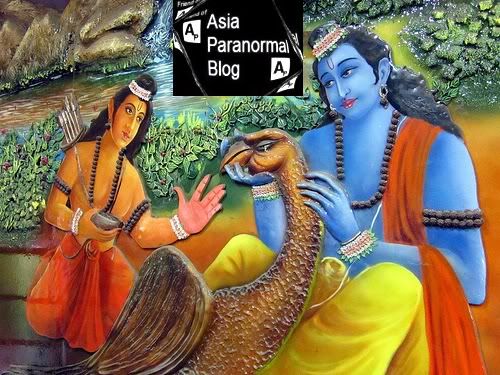
In the Hindu epic Ramayana, Jatayu (Sanskrit: जटायू Jatāyū, Tamil: Chatayu, Thai: Sadayu, Malay: Jentayu or Chentayu) is the son of Aruṇa and nephew of Garuda. A demi-god who has the form of a vulture, he was an old friend of Dasharatha (Rama's father). He tries to rescue Sita from Ravana when Ravana is on his way to Lanka after kidnapping Sita.

4) Garuda
Photobucket

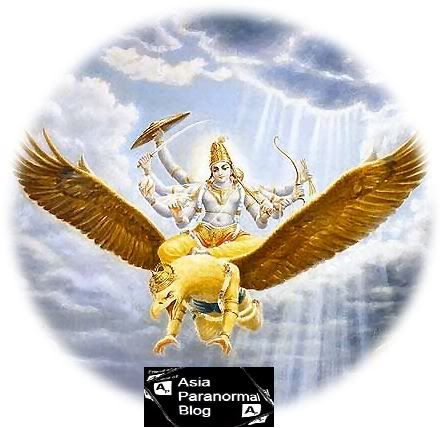
The Garuda (or giant eagle) has a significant place in many Asian legends and history. Garuda is the Malay form of the Phoenix (or the Roc). The Japanese call the Garuda, Karura. In fact, Thailand and Indonesia have the Garuda as their national symbols: The Indonesian national airline is Garuda Indonesia while the Garuda (the king of birds) is also known in Thailand as Krut Pha (a sign of Royal family).

5) Jin


A Jin or spirit from the beliefs of the West Malay people of West Malaysia. He is the guardian of a state known as ‘Royal Musical Instruments’ and he is subject to the King of Jinns, Sang Gala Raja

6) Golbin ( Toyol or Tuyul or Tiyanak )

Photobucket

A Toyol or Tuyul or Tiyanak is a mythical spirit in the Malay mythology of South-East Asia (notably in Indonesia, Brunei, Malaysia, Thailand, Philippine and Singapore).
They can be a small child spirit which is invoked by Dukun (Indonesian shaman) or Bomoh (Malay witch doctor) from a dead human fetus by the means of black magic. Any person can also easily accuquire a Golbin from a Dukun or Bomoh.

Such Golbin can also be babies that died before receive the rites of baptism. After death, they enter place known as Limbo, which is a chamber for unbaptized dead people and such group of dead people are being transformed into evil spirits known to be as Phautasms. Phautasms would then return back into the mortal world as the form of goblins to feast on the living.

However, such golbin can also be the offspring between a demon and a woman . It can as well be the aborted fetus, which comes to life to take revenge on its mother. They are very vengeful creatures.

The owner of such golbin uses it mainly to steal things from other people, or to do mischief. According to a well-known superstition, if money or jewellery keeps disappearing mysteriously from your house, a goblin might be responsible.

A good way to ward off a toyol is to place some needles under your money. This is because goblins are afraid of being hurt by needles.

According to Javanese mythology, the creature is believed to be kept by a person that practicing pesugihan tuyul black magic. This magic helps people to become rich instantly, but in exchange he or she must perform some rituals or offering tumbal (sacrifice something) to keep the goblin happy. The exchange would be that a female member of the family must allow it to breastfeed from her, sucking blood instead of milk.

Most goblins are said to live in forests. If they see a human, they transform into what looks like a normal baby. When the person notices the goblin and comes near to take a look at it, that's when the goblin changes back to its true form and eats its prey.


7) A Bao A Qu

Photobucket

In the Malaysian mythology there is a creature by the name of A Bao A Qu is generally accepted as being pronounced Abang Aku, which means my elder brother

A Bao A Qu was those gods that were caught in this dimension when the gateway closed being unable to return Because it was caught in this world and needed to be able to cross over into its own dimension, it has become attached and dependent on human behavior, beliefs and karma.

A Bao A Qu gains more consciousness, begins to glow in different colors hoping to find itself in the bluish glow of perfection.  It is also said that the many tentacles

8) Pontianak
Photobucket

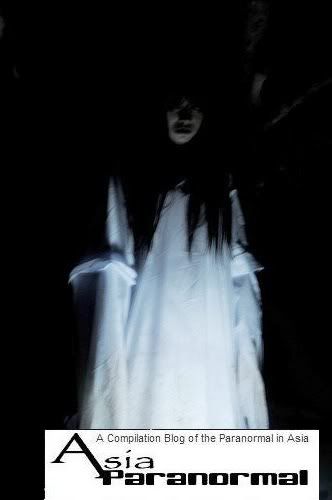
Pontianak is a Malay vampire. Said to be the ghost of a woman who died during pregnancy or childbirth, or the vengeful spirit of a woman murdered by her own lover. Commonly spotted at the roadside or under a tree, sometime accompanied by a baby. Pontianak appear to be young and beautiful so as to entice men to come near, whereby she would then turn into an ugly old woman with sharp teeth who will attack the victim and try to drink their blood. She can be killed by an iron nail driven into her neck, however if the nail is ever removed she will come back to life. She is depicted as wearing a full white dress, which can be bloodstained, with very long hair, long fangs and long fingernails. When she is close to you, she gives off a strong smell like flowers.

9) Kuntilanak

Similiar to Pontianak is the Indonesian Kuntilanak. It commonly takes the form of a bird and sucks the blood of virgins and young women. When a man approaches the Kunitilanak when it is in a female form, she would suddenly turns and reveals that her back is hollow. The bird, which makes a "ke-ke-ke" sound as it flies, may be sent through black magic to make a woman sick, the characteristic symptom being vaginal bleeding

10) Penanggalan

Photobucket

Penanggalan is another type of female vampire who is attracted to the blood of new born infants. Basically it is only the head of a woman with intestines and stomach below the head, from which her entrails trail is used to grasp her victim.

The Philippine Manananggal is a similar vampire who can separate her upper torso from her lower body in order to fly in the night with huge bat-like wings to prey on unsuspecting, pregnant women in their homes, using an elongated proboscis-like tongue.A similar concept is also found with the Thai Krasue
Read more >>

Thursday, November 10, 2011

More Will Die At Bedok Reservoir Says Fengshui Master Lucia Lu of China


30th Oct 2011
After a series of fatal events, Lucia has prompted her curiosity to make a visit to Bedok Reservoir on the 30th Oct 2011, 4pm. She wanted to find out what were the causes that had lead to the fatal accidents. She mentioned that the Fengshui of the reservoir was very bad and there were untold history of that place. Woeful spirits were lurking in that area, calling for mentally unstable individual to join them.

In summary,

1. The reservoir resembles a human skull.

2. The fengshui is worsen by the roads enclosing the reservoir.

3. More people will be affected each year.

4. On 30th Oct 2011, Sunday. She mentioned that a child, a woman and a man, will have 'cases'


[Click here to read full article]
Read more >>

Mythical Creatures: An Introduction to Vampires (Part 2)


Identifying and Killing a Vampire


In the movies, one of the most popular ways to identify a vampire is to see if the suspected casts a reflection in a mirror. If they did not, then they are viewed a creature of the night. In this article, you will learn about ways that people identified vampires

In the past, some believed that you could find the grave of a vampire by leading a virgin boy through a graveyard or church grounds on a virgin stallion. The horse would feel uneasy in the cemetery. Black horses were used for this test, although Albanians were known to use a white horse. If holes were seen in the ground over a grave, it was seen as a sign of Vampirism.

The way a vampire was identified varied from culture to culture. Nature also played a role in keeping vampires away, such as the branches of wild rose, the hawthorn plant, and hanging the aloe vera plant backwards behind a door (according to a South American superstition). Roman Catholics believed that true vampires could not enter a church or holy place because they were servants of the devil. Someone who had an aversion to church and religion was a suspect for being a vampire.

People would dig up graves to prove their theories. Typically, the dead body belonging to a vampire was described as having a healthier appearance than it should – give the rate of discomposure. Sometimes, fresh blood was thought to have been covering the face of the suspected vampire. Villagers would suspect the handiwork of a vampire when the number of deaths among cattle, sheep, relatives and neighbors increased. Some believed that vampires were also connected to activity often associated with poltergeists. If objects moved on their own in a home or if someone felt their skin being touched or pressed in the middle of the night, a vampire could have been behind the actions.

How Can You Kill a Vampire?

One of the most commonly seen ways to kill a vampire is to drive a wooden stake or something similarly sharp through the heart. It has been a long-held belief that you can protect yourself from a vampire by wearing garlic, splashing holy water on the creature, using crosses, and carrying around a Bible. In many books and movies, the home is a safe haven, as vampires need an invitation to enter. It is when a victim unwittingly gives the OK for one to come in that they are placed in danger.

The need to kill a vampire was believed avoided if they were kept from rising from a grave. Some people buried suspected corpses upside down. Some severed the tendons at the knees to keep them from moving. Others placed poppy seeds on the ground around the gravesite so that the vampire would spend all night counting the seeds and find they were helpless against the rising sun. Many believed that vampires had a preoccupation with counting small grains, seeds, or sawdust.

Vampires in Other Cultures: Slavic and India

Vampires in Slavic Folklore

In Slavic folklore, there was a link between vampirism and the way someone was born or died. For example, people born with a caul, teeth or tail are thought to be a sign of the creature. If one was born on a certain day, there was suspicion. People who suffered 'unnatural' deaths or received improper burial rituals were candidates for becoming a vampire. Excommunication was also connected to vampirism. Having red hair led many Serbians to think you had a trait of a vampire.

The concept of vampirism was taken seriously by some, as they followed a host of preventive measures to make sure no vampires roamed the earth at night. Burial rituals reflected the fear of vampires. Crucifixes were placed in coffins and blocks situated under the chin to prevent the body from eating the shroud.
Corpses were sometimes pierced by thorns or stakes to prevent a vampire from leaving the coffin. Some believed that the stakes would pierce through the vampire and pin them down into the ground. If a person suspected of being a vampire was buried, scythes were placed above their necks, so that if they rose in the middle of the night, they would be decapitated.

Villagers believed that they were in the midst of vampire activity when cattle, sheep and people were mysteriously found dead. The Slavic believed that vampires were afraid of garlic and had a compulsion to count particles of grain, sawdust and similar materials. This is why sometimes, grains or sawdust were placed in the coffins of suspected vampires.

The Slavics believed you could kill a vampire by staking it, decapitation (with some people placing the head between the feet), burning, sprinkling holy water on the body, and repeating the funeral service. Others felt that a vampire could be exorcised. In Serbian folktales, the most well-known of vampires was Sava Savanovic, who appeared in a novel by Milovan Glisic.

Vampires in Indian Beliefs

Ancient text associated with Roma, India has some descriptions of vampires. The culture referred to such a creature as the Bhut or Pret, which was the soul of a man who had died before it was his time. The spirit was thought to roam about until it found a dead body to animate during the night. As a result, the dead body would attack the living – quite similar to what ghouls were believed to do.

In the northern part of India, the people believed in the Brahmarak Shasa, which was a creature with vampire-like characteristics. Its head was surrounded by intestines and a skull from which it drank blood. Another creature associated with Indian vampire beliefs were the Vetala. From Hindu mythology, Vetala was a ghost-like being that were seen as spirits that took over the bodies of corpses. When the Vetala inhabits the body, the corpse is able to move and the process of decay stops during this time. The spirit is able to leave when it wishes.
Read more >>

Wednesday, November 9, 2011

23:59 The Movie

Submitted By : The SAF Regular


The Movie
Have you Watched the horror movie which is pretty hot in Singapore recently known as 2359 ?

This Movie is directed by Gilbert Chan ,produced by multiple award-winning producer Eric Khoo and staring Mark Lee. The is a Singaporean Horror Movie and as for those who had been through army especially if you have been to pular tekong before, you will most probably be able to appreciate this movie even more and might not mind watching it more than once.

2359 Pic 01

This movie itself, is absolutely very Singaporean in how it portrays the daily lives of Singaporean males in their national service 2 years of their time.

If you were to compare with horror movies or other Asian countries , you might be disappointed and might think this movie fall short of your expectations. If you were to further compare it with western horror movies it will most likely be an immediate conclusion that this is a very lousy movie.

However if you were to compare it with Singapore made movies, this movie has an Singaporean taste in it. It is very Singaporean and in comparison with other Singaporean made movies, this movie is already good enough for a Singaporean level.

2359 Pic 03

Movie Very Hot
For your information, since the sneak preview till the official launched of this movie 2359, it is as good as everyday , in every cinema and every time slot that it is full house till there are even people who sits on the floor and stairs of the theater. This is still something that is still happen even till today in case if you are not aware of it.

2359 Pic 02

Basically, this story speaks of the most famous and legendary 3rd door bunk of pular tekong but it is however more or less modified already from the original story. Despite so, much of the elements and essences of the most original story is still there.

Synopsis
The below will be the synopsis of this movie

2359 is a horror thriller set in 1983 on an island used for military training.

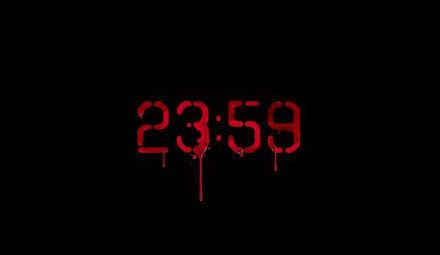
A rumour had been circulating like wild fire amongst the soldiers. A mad woman living on the island had died at the exact hour of 23:59, and it is believed that her spirit had returned to haunt the soldiers at the exact same time.

One of the recruits, Tan, the introverted platoon outcast, is adamant that he will be the next victim of the mad woman's spirit.

He tries to convince his buddy Jeremy that the woman's spirit has been visiting him every night. Jeremy laughs it off and claims that there are no such things as ghosts in this world. They only exist because of Tan's overactive imagination.

However, during the 24 km road march for the platoon in the forest, Tan was found dead by the river, with his limbs contorted in a strange way and an expression of deep fear on his face.

Overwhelmed with guilt, Jeremy decides to investigate Tan's death, convinced that it was not an accident as what the military officers believe.

Little does he know that the truth behind Tan's death will unearth a terrible dark secret of the island and he will have to confront his deepest fears in order to find the truth.

This is the trailer of this movie


[Click here to read full article]
Read more >>

A Chinese Curse or Blessing? (May you live in interesting times)

By : Gong Tao Siao

May you live in interesting times

"May you live in interesting times." Thus goes the first part of the famous Chinese curse, or at least the curse commonly attributed to the Chinese. Like all good curses at first sight it could be mistaken as a blessing. This curse has, in fact, long been granted to and put upon Chinese writers and artists: they have certainly been living in interesting times.

Back in 1972, shortly after Nixon's visit to China, Susan Sontag wrote her short story "Project for a Trip to China." While calling China "the most exotic place of all" and her planned trip to the country a "mythical voyage," she also admitted that "mythical voyages were to places outside of history" yet "now such voyages are entirely circumscribed by history." In other words, Sontag felt she was merely a tourist fantasizing about a "real" China that she could not enter.

The "real" China, however, can be a real curse. About the same time, an anonymous, lone Chinese youth, who would later go under the poetic pseudonym Duo Duo, was writing secretly about the birth of a new subjectivity that had been alienated and isolated in the night of history. This night provided such uncanny visions:

[Click here to read full article]
Read more >>

Mythical Creatures: An Introduction to Vampires (Part 1)

by Yona Williams

Lately, there has been an explosion of vampire interest – from the Sookie Stackhouse 'True Blood' books to the remake of the movie, 'Fright Night.' The concept of a supernatural being with a thirst for blood has created faithful followers looking for the next character to go for the jugular. In this article, you will learn information regarding the vampire and its place in the world of mythical creatures.

What is a Vampire?

A vampire is considered a member of the 'undead.' They drink the blood of the living in order to survive and are typically portrayed as not being able to come in contact with the sunlight.

Origin of the Vampire

The history of vampires dates back thousands of years with a variety of cultures embracing the notion that bloodsuckers thrived among the living. From vampire foxes in Japanese myths to ancient Greek mythology, endless forms of the vampire concept have emerged. Over the years, the characteristics and features of vampires and vampire-like creatures have evolved. The creatures associated with ancient civilizations are much different than what we hear about today – most of the characteristics that are prominent when speaking about vampires come from early 18th-century descriptions and accounts from southeastern Europe.

Vampires of Ancient Civilizations


Early cultures and ancient civilizations have told tales of vampires and creatures that are described as being similar to a vampire. Most of the stories involve the dead or undead that feeds or kills the living. The Babylonians believed in the Lilu – vampire-like demonic spirits. Sumerian mythology spoke of the Akhkhar – bloodsuckers from ancient times. The female demons roamed the earth when it was dark. They hunted and killed newborn babies, as well as took the lives of pregnant women. One of the demons in old tales was named Lilitu. She was later adapted by the Jewish culture and renamed Lilith.

In India, there were the ghoul-like vetalas that inhabited the bodies of the dead and were found in old Sanskrit folklore. One popular story includes King Vikramaditya and his nightly missions to capture a vetala. The legend is found in a book called Baital Pachisi, which speaks of an undead creature, who had a link to the bat. The creature hung upside down in trees situated close to cemeteries and cremation grounds. The Chinese spoke of the 'hopping corpse,' which had some of the same characteristics as the vampire. The creature was described as taking the life essence of a human (known as the chi) instead of draining the blood from a body.

The ancient Egyptians spoke of a goddess that turned bloodthirsty after slaughtering humans. The only thing that satisfied Sekhmet was to drink blood-colored alcohol. The ancient Romans spoke of the strix – a nocturnal bird that fed on the flesh of humans and their blood.

Different Kinds of Vampires

Vampires are known for their immortality. Books and movies portray the creatures as assuming endless identities and living through the centuries – adapting and changing with the times. In some circles, they are known by a more scientific name – Home Wampyrus. There are different classifications to note, as mentioned in this article.

Homo Wampyrus Draco

The most well-known type of vampire is called the Homo Wampyrus Draco. This is the kind of vampire that appears in tales told by Bram Stoker. They mostly lead the life of a count and emerge in many different accounts from around the world – from North America to the western part of Europe. The appearance of the vampires is closest to humans. It is rare that people would notice that they have retractable canine teeth in their upper jaws. Their tolerance to light is medium to poor, and will die if they are exposed to a couple of hours of direct sunlight. The Homo Wampyrus Draco socializes well with humans and often takes jobs at night in their presence.

The Draco variety often gets their fill of blood with the help of willing participant who think they are dealing with mortal blood drinkers. However, when they place fear in the hearts of humans, they enjoy a boost in adrenaline that makes taking blood by force a pleasurable adventure. This kind of vampire is shown in movies, such as 'Blade' and 'The Lost Boys.' They often recruit humans to further their cause because they make life as a vampire as being fun. Some humans will do anything for the chance to become a vampire after 'helping', 'serving' or 'proving themselves'.

Homo Wampyrus Chiroptera

Considered the rarest type of vampire, Homo Wampyrus Chiroptera is the 'bat' vampire, where they are mostly found in Africa, New Zealand and South America. The majority of the population were also found dwelling in China and India. The vampires look quite human, but have slightly pointy ears. Some of the creatures feature a lantern jaw. They can mix in the social setting of humans, but avoid crowds. Out of all the vampire types, it is said that this kind is the most sensitive to sunlight. When in the sun for a period of time, they develop blisters and pain. The vampires have the ability to shift into other shapes and change into the iconic vampire bats. This transformation occurs when certain conditions are in place, such as racial background, length of time being a vampire, and eating the right food.

What is a Mortal Vampire?

A mortal vampire is one who is fascinated with drinking blood and adopting the lifestyle of what they believe a vampire to be. They may drink blood because they believe they are a vampire or feel sexually excited when they engage in the typical behaviors. Many people with this fascination will buy blood from blood banks in states that allow such a practice or seek willing "donors" to live out their vampiric lifestyle.

Not all vampires look as similar to humans as the ones you see in popular films. Some display deformities that keep them out of public view. Others have the characteristics of other creatures. In this article, you are introduced to a couple of types of vampires that do not look like the Dracula you are used to seeing.

Homo Wampyrus Nosferatu

Some vampires do not look like humans, but are 'deformed' in appearance. The Homo Wampyrus Nosferatu variety was highlighted in the movie called "Nosferatu," which debuted in 1922. Transforming into this type of a vampire is not a smooth one. Their immune system has fought the virus associated with vampirism and as a result, the virus mutates to survive. Because of this, the vampire is disfigured with unpleasant physical characteristics. Their head is usually high and domed in shape. They are bald with a visible system of veins. Their face is long and thin – drawn in with deep creases. The eyes sink in the head and they have large, pointy ears. The nose turns upwards and reveals their nostrils.

On the hands of the vampire, there are long, tapered fingers with discolored nails. The twisted features of their body extend to their spine. They must stand with a hunch to avoid pain. Straightening out the back is extremely painful and could cause a slipped disc. Their physical appearance leads them to live a life that is often separate from humans, as well as other vampires. Farm animals, small children and sleeping humans are the source of blood for the Homo Wampyrus Nosferatu. Accounts of this type of vampire have appeared in Africa, South Africa, the Caribbean, and Japan. In Puerto Rico, the Chupacabras they speak of are thought to be a form of the Nosferatu vampire.

Homo Wampyrus Sauria

With reptilian or lizard-like features, the Homo Wampyrus Sauria is a type of vampire that possesses teeth with sharp points that are quite similar to large lizards. They are considered to be the most social out of the most popular types of vampire – probably because they can take exposure to sunlight for extended periods of time. Some can stay in the sun for a great deal of time when slathered in sunscreen or wearing sunglasses. Their appearance is rather similar to that of a human with the exception of their teeth.

In the past, it is said that the Sauria use horrifying methods to attack their victim when they feed, such as ripping away large pieces of flesh. They often go after the upper arm, thigh, or throat. As they eat the flesh, they drink the blood that spills from the leaking wound until the victim dies. Nowadays, this rarely occurs, as they now purchase blood or use willing donors that are cut with razors instead of ripped apart using their teeth.
Read more >>

Tuesday, November 8, 2011

Water Festvial of Asia

Contributed By :  Chan ShiJie
Water Festival

A very Asian Based Festival known as Water Festival which westerners literally translates it. This Festival can be found mainly in south east Asian countries but however it may varies in the individual countries.

Countries that celebrate the water festival are as Follows :
1. Yunnan of China By the Dai Ethnic minority known as Pou Shui Jie
2. Myanmar / Burma known as Thingyan
3. Thailand / Siam known as Songkran
4. Laos known known as Pi-Mai
5. Cambodia known as Bonn Om Touk
6. Singapore : SIWF (Singapore International Water Festival)

The Dates of this water festival in the Year of 2011 for :
China, 14-16 April
Myanmar, 13-17 April
Thailand , 11-18 April
Laos, 13-15 April
Cambodia, 10-12 November
Singapore, 01 July

China

Water Festvial China 02

During this 3 days of festival, Blessings is being received by splashing water at each other. Besides Splashing of water at each other like nobody's business, there are interesting activities that can be taken part such as dragon boat matches , a lot of Singing and Dancing as well. A very merry making festival indeed.

The 3 days of celebrations is very rich and experiencing. It more than just about receiving blessings by splashing water or just mere merry making alone. It is also at the same time about romance as well too !

Water Festvial China 03

Myanmar/Burma

Water Festvial Myanma Burma 01

Local belles have been rehearsing for weeks and even years, in the run-up to the great event in song and dance in chorus lines, each band of girls uniformly dressed in colourful tops and skirts and garlanded in flowers and tinsel. They wear fragrant thanaka - a paste of the ground bark of Murraya paniculata which acts as both sunblock and astringent - on their faces, and sweet-scented yellow padauk blossoms in their hair. The padauk (Pterocarpus macrocarpus) blooms but one day each year during Thingyan and is popularly known as the "Thingyan flower".

Large crowds of revelers, on foot, bicycles and motorbikes, and in open top jeeps and trucks, will do the rounds of all the mandats, some making their own music and most of the womenfolk wearing thanaka and padauk. Floats, gaily decorated and lit up, also with festive names and carrying an orchestra as well as dozens of amorous young men on each of them, will roam the streets stopping at every mandat exchanging songs specially written for the festival including the Thingyan classics that everyone knows, and performing than gyat

It is indeed a time for letting go, a major safety valve for stress and simmering discontent. Generally however friendliness and goodwill prevail along with some boisterous jollity.

Water Festvial Myanma Burma 04

Thailand

Water Festvial Thailand 03

Typically, the water festival is known as Songkran in Thailand. People will roam the streets with containers of water or water guns or post themselves at the side of roads with a garden hose and drench each other and passersby. However, the main activity is more than just this. It is also about visiting and pay respects to elders, including family members, friends, neighbors, and monks.

Water Festvial Thailand 02

Laos

Water Festvial Laos 01

Lao New Year is the most widely celebrated festival in Laos. The festival is also celebrated by Laotians in the USA, Canada, France, and Australia. Lao New Year takes place in April, the hottest time of the year in Laos, which is also the start of the monsoon season. Lao New Year takes place at roughly the same time as Songkran in Thailand and Chaul Chnam Thmey in Cambodia.

Water Festvial Laos 02

The official festival lasts for three days from April 13th to April 15th (although celebrations can last more than a week in towns like Luang Prabang). The first day is the last day of the old year. Houses and villages are properly cleaned on the first day. Perfume, water and flowers are also prepared for the Lao New Year. The second day of the festival is the "day of no day", a day that falls in neither the old year or the new year. The last day of the festival marks the start of the new year

Water
Pi Mai celebration, flour throwing
Water is used for washing homes, Buddha images, monks, and soaking friends and passers-by. Students first respectfully pour water on their elders, then monks for blessings of long life and peace, and last of all they throw water at each other. The water is perfumed with flowers or natural perfumes. Some people prefer flowers in the water to give a pleasant smell, as well as adding cologne/perfume. . Over the years another tradition has developed with Lao New Year: people will smear or throw cream (shaving cream or whipped cream) or white powder on each other during the celebrations.

Cambodia

Water Festvial Cambodia 05

The Cambodia Water Festival or ‘Bon Om Tuk’ in Khmer is the largest festival in the Cambodian calendar and an amazing sight to behold! The 3-day Water Festival in Phnom Penh is of great significance as it celebrates the end of the rainy season, the start of the fishing season, and also the unique natural phenomenon - the flow of the Tonle Sap river changing direction! And not only this, the Cambodia Water Festival also coincides with the full moon of the Buddhist calendar month of Kadeuk, this full moon is traditionally a good omen promising a bountiful harvest.

Water Festvial Cambodia 04

There is often a parallel festival at Angkor Wat and although it is smaller in scale it is just as impressive due to the backdrop of Angkor Wat.

The festival marks the changing of the flow of the Tonle Sap River and is also seen as thanksgiving to the Mekong River for providing the country with fertile land and abundant fish. It is at this time when the river flow reverts to its normal down-stream direction. In a remarkable phenomenon, the Tonle Sap River earlier reverses its course as the rainy season progresses, with the river flowing "upstream" to Tonle Sap Lake. Then as the rainy season tapers off, the river changes direction once again as the swollen Tonle Sap Lake begins to empty back into the Mekong River, leaving behind vast quantities of fish.

Singapore

Water Festvial Singapore 02

With the objective of bringing the young people together, Singapore in the very recent years came up with their very own water festival uniquely, Singapore !

This Water Festival is known be as the : Singapore International Water Festival (SIWF) acting as a platform to bring the young together and to celebrate her achievements in the world of water since the year of 2009.

[Click here to read full article]
Read more >>
 
Asia Paranormal Google Page Rank
AsiaParanormal Blogger Template "Sleek 2" Designed by HypeSeek © 2012