Ritual to infuse the power of prayer into your body:
First, prepare item as below:
1. Some leaves of kafir lime that have been exposed to morning sun
2. Coarse salt
3. Weeds 3 pieces
Crash all the ingredients to fine pieces into a half glass of plain water.
Clean yourself and bring the mixture outside of your house. Find a quiet place so that you will not be disturbed.
Put the glass directly onto the floor a few feet in front of you, and then take posture as if a tiger. Craw until your belly is directly over the glass. When you have done so, recite the above prayer slowly for 444x. After that, blow four breaths towards the water.
Now you can sit cross-legged on the floor and use your right hand to squeeze the mixture in the glass until the aroma is released. After that, wipe the liquid all over your body, pay attention to your face. This is because the heart of hypnotizing power is hidden in the face. But remember, you must control yourself so as not to roar like a tiger … or you will be part of the weretiger family J.
When you have completely rub the water all over your body, then my friend, you will feel your body hair stands up straight as if touched by small static electric charge. Let it be as your body is in the process of absorbing the nutrients and power of a tiger, you are allowed to return home once you feel calmer.
If you heard one roar, then reply with “waalaikummussallam”. If you heard a second roar, then do not respond as this is the challenge of other weretigers.
You can clean yourself once you are safely inside your house.
It is advisable to perform this ritual once a month if you want to further into the world of weretigers.
To activate the power:
1. Recite the prayer above 4x then release your breath to your right index finger.
2. Rub your index figure on the part between your nose and lips:
a. For paralyzing power: Rub your finger from top down.
b. For business, interview etc: Rub your finger from down up.
3. To be invisible from your enemy:
a. Get a piece of weed and place it horizontal below your nose, recite the prayer 4x and break the weed. Throw one half to your right, and the other to your left. But you are forbid to touch the body of your enemy, if you do so, he will be able to see you.
4. You must recite the prayer 4x before you sleep every night to maintain its power. It is said that once you have mastered this spell, you can even tame a wild tiger.
Harimau Jadian or Weretiger is also known as Hantu Belian. A weretiger is said to be originated from a person who has mastered the art of weretiger or it can be inherited from father to son. This type of spell enables a person to possess the ability to transform oneself into a tiger while he/she is alive or after he/she is dead. The original purpose of learning this art was for self protection. Just think of the fact that about a century ago, majority of the South East Asia areas are covered by forests. The most powerful creatures roaming about were tigers. Hmm… I hear you, but there are no lions around then.
Local folks believe that the weretigers have independent government with king, ministers, soldiers etc. It is said that the weretigers hung human hairs in front of their houses as a signature mark.
Many people believe that the weretigers are originated from Kerinchi in Sumatra. Folks over there possess the ability to turn themselves into real tigers. According to ancient stories, in order for a person to turn into a tiger, he/she must possess a piece of sarung with black and yellow stripes as if that of a tiger.
Long ago, when I was still in diapers, toddling around the jungles of northern Thailand with my missionary folks, they had a get together with all their missionary friends.
One of the older missionaries, a wise and respected man, told this story.
“We had just moved to a new village, and several people were coming to Jesus. The local witch doctor was angry about it. We found strange things outside our door, and outside the other Christian’s doors . . . cursed items and the like. The witch doctor was powerful, but I wasn’t worried.
But one night, as I lay sleeping, I woke up and smelled a tiger (tigers have a powerful, unmistakable scent). Thinking it was underneath the hut (his hut was on stilts) I jumped out of bed to find my gun. But the Tiger was standing at the foot of my bed!
According to legend there are several ways by which a person can be transformed into this nasty feline monster.
Some believed that only the people who had led a bad life and only asked for forgiveness as they were dying would transform into this tiger-like monster.
In Malaysia, people were said to be able to choose to become one of these beasts.
Some did it to get revenge and others simply because they craved the power, strength and violence.
In the cultures of the West, Werewolves and Vampires are very much popular.
However in the East, where Asians lived in, it is instead more about Weretigers.
While werewolves were thought to be the predators of vampire by nature but however, most of the time these predators are in the control of their prey, the Vampires in most stories.
So , Werewolves are by nature predators of Vampires and in turn the are the prey to their predators , the Weretigers whom are mostly Asian, their distant cousin!
We have all heard of the werewolf. The werewolf has a distant cousin, so to speak. Not as well known outside of Asia, is a mythical creature called a weretiger, also more recently known as a werecat. Before the late 19th century they were all known as weretigers. They are not to be mistaken for the spirit tiger which is a familiar under the control of a supernatural being or a “nat”. The familiar is used to do the bidding of the nat.
Asia Paranormal is proud to announce a collaboration with Dr Ong Hean Fatt, the Feng Shui Scientist on this Seminar: Singapore's Haunted Places: Science & Feng Shui
This unique seminar is a new indepth practical approach to haunting with international scientific findings. Find out latest startling scientific findings on true nature and factors of haunting, e.g.:
*Scientific physical geography guidelines to identify areas in Singapore prone to haunting
*Haunting conditions cause sickness and even cancer. Learn how to deal with haunting!
*Special exercise to find out if you are sensitive to haunting!
*What you are going to learn may save your life or those close to you!
Based on scientific research analysis of over 50 haunted sites in Singapore through field visits, study of topography and geology maps. The haunting can be associated with hilly terrain and faultlines. Scientific factors include winds, infrasounds, radon and piezoelectricity.
Program Outline: Morning
*Scientific Physical Geography Features of Haunting in Singapore Coffee Break
*Feng Shui of Haunting in Singapore as Practical Criteria to House & Office Buying
Lunch Afternoon
*Astrology of People Sensitive to Haunting: Can you stay in a haunted place?
Coffee Break
*Practical Scientific Treatments and Remedies for Haunting Problems
*Special insight: Enigma of Singaporean boy lost in Fraser’s Hill, June 2005.
Hurry! Seats may be limited.
Seminar: Saturday October 27, 2012, 9.00 am to 5.00 pm.
Venue: To be confirmed
Fees: S$350 pax, Meals and Lecture notes included
Free complimentary ebook to Early Birds/members
Early Bird Special: Register before 15th August and quote "Asia Paranormal" and you will get an early bird discounted price of S$250
Why and what makes Preta an ancient Asian wonder of the world ?
view videos as follows :
Petra Jordan one of the new world wonders, and rightfully so. Enjoy this spectacular rose red ancient city. The Treasury and Monastery Mysterious lands mythical locations paranormal activity ufo sighting ghost sighting Archaeologic site in Jordan famous for its many stone structures carved in rock. Re-discovered in 1812 by the Swiss explorer Johann Burckhardt, Petra was the capital of the ancient Nabateans and was the center of their caravan trade. They controlled the flow of water to the city creating a natural oasis
Al Khazneh, one of the ancient world's most magnificent ancient megastructures which humans display formidable resourcefulness and courageous endeavour to create. It was generally believed to be built between 100 BC and 200 AD. Petra is a historic and archaeological city in the Jordanian governorate of Ma'an that has rock cut architecture and water conduits system. Established sometime around the 6th century BC as the capital city of the Nabataeans, it is a symbol of Jordan as well as its most visited tourism attraction. It lies on the slope of Mount Hor in a basin among the mountains which form the eastern flank of Arabah, the large valley running from the Dead Sea to the Gulf of Aqaba. Petra was chosen as one of the New Seven Wonders of the World in July 7, 2007 and a World Heritage Site since 1985. Petra was chosen by the BBC as one of "the 40 places you have to see before you die". The site remained unknown to the Western world until 1812, when it was introduced by Swiss explorer Johann Ludwig Burckhardt. Stations 19 through 26 of the stations list of Exodus are places associated with Petra. (The stations list is the list of the 42 Stations or Mansions visited by the Israelites following their exodus from Egypt as described in the Bible). This part of the country was Biblically assigned to the Horites, the predecessors of the Edomites.
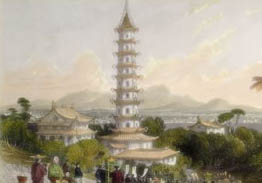
The Porcelain tower of Nanjing, also known as the Temple of Gratitude, is one of the marvels that appears on the list of the Seven medieval wonders of the world. This great construction was the highest building in China at the time of its construction and was set to dominate the banks of the River Yangtze for over 400 years before it met its grisly end. The porcelain tower of Nanjing was one of the most breathtaking constructions of its time and truly deserves its place in the 7 wonders of the medieval world category.
Why and what makes the Great wall of China a Wonder of Ancient Asia ?
Please view videos :
The Great Wall of China is a series of stone and earthen fortifications in northern China, built, rebuilt, and maintained between the 5th century BC and the 16th century to protect the northern borders of the Chinese Empire. Since the 5th century BC, several walls have been built that were referred to as the Great Wall. One of the most famous is the wall built between 220206 BC by the first Emperor of China, Qin Shi Huang. Little of that wall remains; the majority of the existing wall were built during the Ming Dynasty.
The Great Wall stretches from Shanhaiguan in the east to Lop Nur in the west, along an arc that roughly delineates the southern edge of Inner Mongolia. The most comprehensive archaeological survey, using advanced technologies, has recently concluded that the entire Great Wall, with all of its branches, stretches for 8,851.8 km (5,500.3 mi). This is made up of 6,259.6 km (3,889.5 mi) of sections of actual wall, 359.7 km (223.5 mi) of trenches and 2,232.5 km (1,387.2 mi) of natural defensive barriers such as hills and rivers.
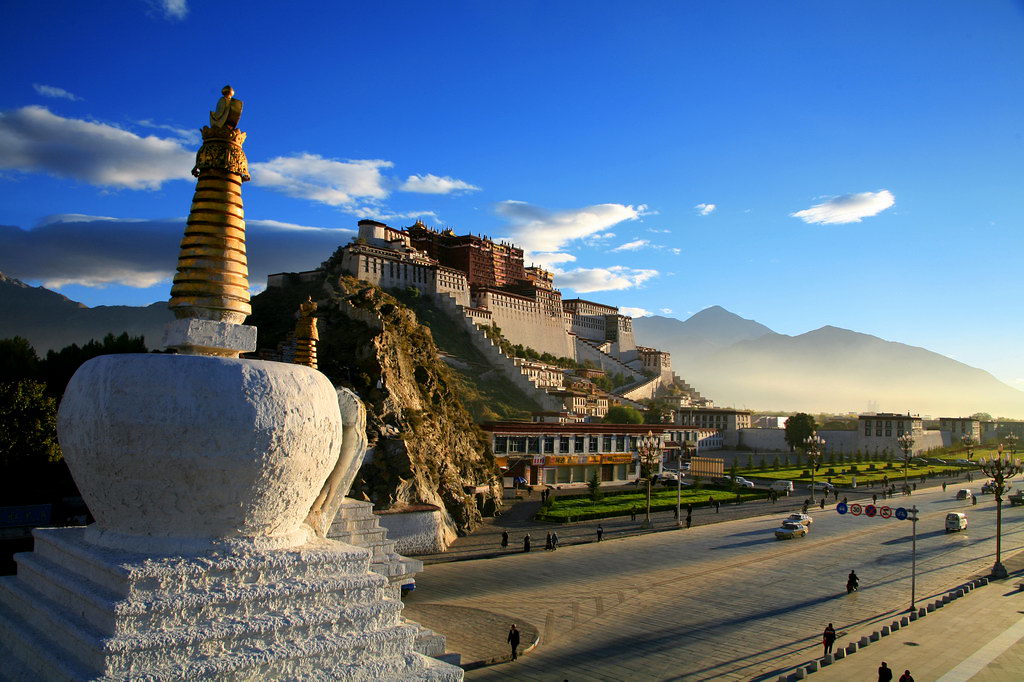
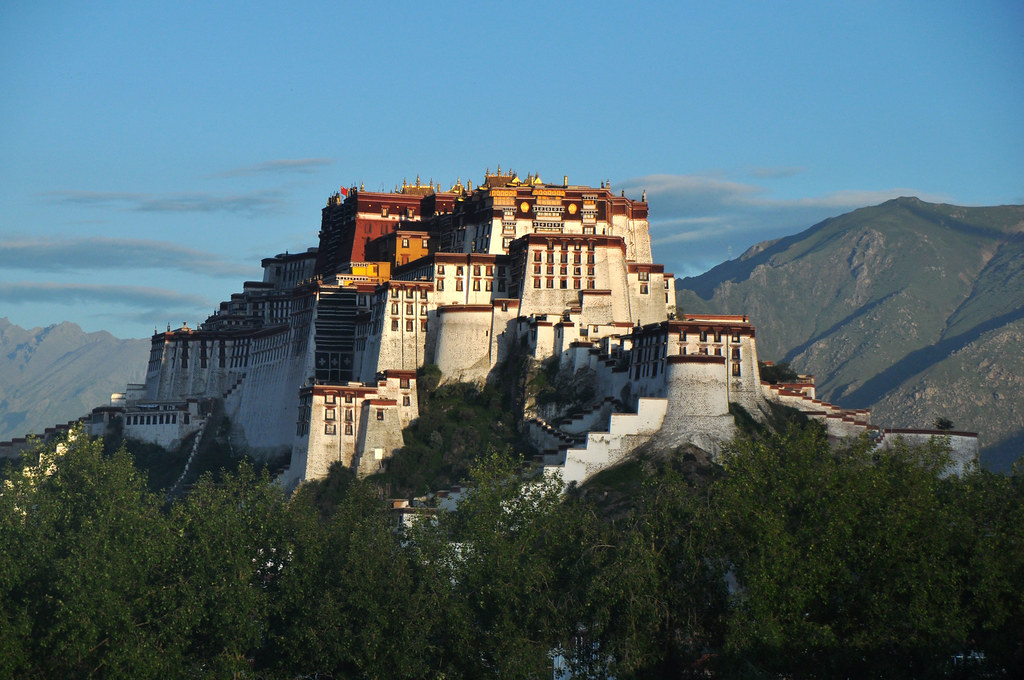
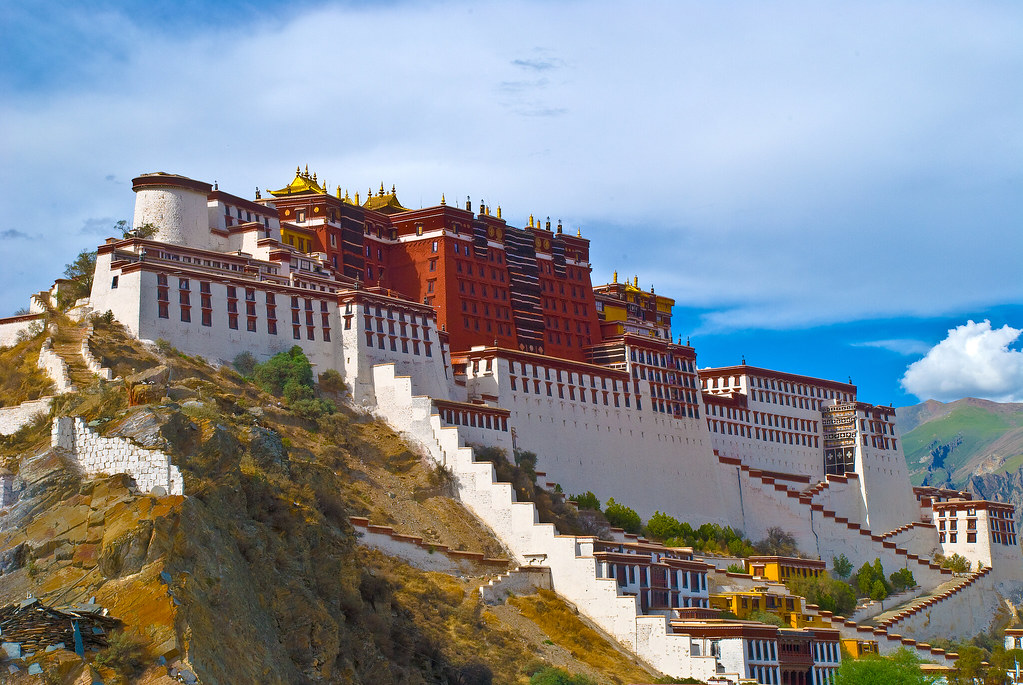
Potala Palace, the Indestructible Palace which is Earthquake Proof is in Tibet , China. It is classified as one of the Ancient Asian Wonders of the World
The building measures 400 metres east-west and 350 metres north-south, with sloping stone walls averaging 3 m. thick, and 5 m. (more than 16 ft) thick at the base, and with copper poured into the foundations to help proof it against earthquakes
What and why makes the Taj Mahal an ancient Asian wonder of the world ?
Please view video as follows :
The Taj Mahal (also "the Taj"), located in Agra, is considered the finest example of Mughal architecture, a style that combines elements from Persian, Turkish, Indian, and Islamic architectural styles. The focus of the Taj Mahal is the white marble tomb, which stands on a square plinth consisting of a symmetrical building with an iwan, an arch-shaped doorway, topped by a large dome. It was built by the Mughal emperor Shah Jahan (1628-1658), grandson of Akbar the great, in the memory of his queen Arjumand Bano Begum, entitled 'Mumtaz Mahal'. The plinth and tomb took roughly 12 years to complete. The remaining parts of the complex took an additional 10 years and were completed in order of minarets, mosque and jawab and gateway. A labour force of 20,000 workers was recruited across northern India.
The Taj Mahal was built on a parcel of land to the south of the walled city of Agra. Shah Jahan presented Maharajah Jai Singh with a large palace in the center of Agra in exchange for the land. An area of roughly three acres was excavated, filled with dirt to reduce seepage and leveled at 50 meters above riverbank. In the tomb area, wells were dug and filled with stone and rubble as the footings of the tomb. Instead of lashed bamboo, workmen constructed a colossal brick scaffold that mirrored the tomb. The scaffold was so enormous that foremen estimated it would take years to dismantle. According to the legend, Shah Jahan decreed that anyone could keep the bricks taken from the scaffold and thus was dismantled by peasants overnight. A fifteen kilometer tamped-earth ramp was built to transport marble and materials to the construction site. Teams of twenty or thirty oxen were strained to pull blocks on specially constructed wagons. An elaborate post-and-beam pulley system was used to raise the blocks into desired position. Water was drawn from the river by a series of purs, an animal-powered rope and bucket mechanism into a large storage tank and raised to large distribution tank. It was passed into three subsidiary tanks, from which it was piped to the complex.
The plinth and tomb took roughly 12 years to complete. The remaining parts of the complex took an additional 10 years and were completed in order of minarets, mosque and jawab and gateway. Since the complex was built in stages, discrepancies exist in completion dates due to differing opinions on "completion". For example, the mausoleum itself was essentially complete by 1643, but work continued on the rest of the complex. Estimates of the cost of the construction of Taj Mahal vary due to difficulties in estimating construction costs across time. The total cost of construction has been estimated to be about 32 million Rupees.
The Taj Mahal was constructed using materials from all over India and Asia. Over 1,000 elephants were used to transport building materials during the construction. The translucent white marble was brought from Rajasthan, the jasper from Punjab, jade and crystal from China. The turquoise was from Tibet and the Lapis lazuli from Afghanistan, while the sapphire came from Sri Lanka and the carnelian from Arabia. In all, twenty eight types of precious and semi-precious stones were inlaid into the white marble.
A labour force of twenty thousand workers was recruited across northern India. Sculptors from Bukhara, calligraphers from Syria and Persia, inlayer from southern India, stonecutters from Baluchistan, a specialist in building turrets, another who carved only marble flowers were part of the thirty-seven men who formed the creative unit. Some of the builders involved in construction of Taj Mahal are:
The main dome was designed by Ismail Afandi (a.k.a Ismail Khan),of the Ottoman Empire and was considered as a premier designer of hemispheres and domes.
Ustad Isa of Persia (Iran) and Isa Muhammad Effendi of Persia (Iran), trained by Koca Mimar Sinan Agha of Ottoman Empire, are frequently credited with a key role in the architectural design, but there is little evidence to support this claim.
'Puru' from Benarus, Persia (Iran) has been mentioned as a supervising architect.
Qazim Khan, a native of Lahore, cast the solid gold finial.
Chiranjilal, a lapidary from Delhi, was chosen as the chief sculptor and mosaicist.
Amanat Khan from Shiraz, Iran was the chief calligrapher. His name has been inscribed at the end of the inscription on the Taj Mahal gateway.
Muhammad Hanif was a supervisor of masons and Mir Abdul Karim and Mukkarimat Khan of Shiraz, Iran (Persia) handled finances and management of daily production.
Commissioned in 1632 by the Mughal emperor Shah Jahan to house the remains of his cherished wife, the Taj Mahal stands on the southern bank of the Yamuna River in Agra, India. The famed mausoleum complex, built over more than 20 years, is one of the most outstanding examples of Mughal architecture, which combined Indian, Persian and Islamic influences. At its center is the Taj Mahal itself, built of shimmering white marble that seems to change color depending on the sunlight or moonlight hitting its surface. Designated a UNESCO World Heritage site in 1983, it remains one of the world's most celebrated structures and a stunning symbol of India's rich history.
Taj Mahal: Shah Jahan's Romantic Gesture
Shah Jahan was a member of the Mughal dynasty that ruled most of northern India from the early 16th to the mid 18th-century. After the death of his father, King Jahangir, in 1627, Shah Jahan emerged the victor of a bitter power struggle with his brothers, and crowned himself emperor at Agra in 1628. At his side was Arjumand Banu Begum, better known as Mumtaz Mahal ("Chosen One of the Palace"), whom he married in 1612 and cherished as the favorite of his three queens.
In 1631, Mumtaz Mahal died after giving birth to the couple's 14th child. The grieving Shah Jahan, known for commissioning a number of impressive structures throughout his reign, ordered the building of a magnificent mausoleum across the Yamuna River from his own royal palace at Agra. Construction began around 1632 and would continue for the next two decades. The chief architect was probably Ustad Ahmad Lahouri, an Indian of Persian descent who would later be credited with designing the Red Fort at Delhi. In all, more than 20,000 workers from India, Persia, Europe and the Ottoman Empire, along with some 1,000 elephants, were brought in to build the mausoleum complex.
Wonderfull documentary by National Geographic about the Taj Mahal, world's greatest and divine symbol of true love.